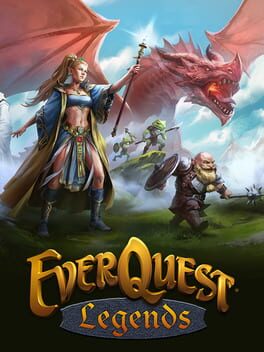
EverQuest Legends arrived late last month as a loving reconstruction of the 1999 original, rebuilt by Game Jawn with Daybreak's explicit permission. The game carries a $20 upfront cost and a recurring $10 subscription, positioning itself as a premium alternative to the free-to-play Project 1999. For anyone who ever feared getting lost in West Freeport or dreaded the corpse run back to their body, this release represents a specific proposition: the authentic EverQuest experience, minus the cruelest friction.
Quick Facts — EverQuest Legends
| Developer | Game Jawn |
|---|---|
| Platform(s) | PC |
| Release Date | late last month |
| Genre | MMO |
| Price | $20 and recurring $10 sub |
The significance here extends beyond nostalgia. Modern MMOs have largely converged on streamlined, accessible designs that respect player time above all else. EverQuest Legends deliberately rejects that consensus, preserving glacial walk speeds, approximately 4,600 distinct equipment slots, and MUD-era commands like CONSIDER and WHO. It's a game that expects you to learn its language rather than translating itself for you. That refusal to compromise makes it fascinating — and severely limits its audience.
The Context: Why This Exists Alongside Project 1999
Project 1999 has operated for years as a free-to-play preservation of classic EverQuest with Daybreak's blessing. It serves as a historical curiosity — something you sign into once, get your nostalgia hit, and abandon until the urge returns years later. The author describes it as a place you can visit but probably won't stay. That distinction matters because EverQuest Legends isn't trying to be a museum piece; it's trying to be a home.
Game Jawn, a studio comprised of EverQuest fans-turned-developers, made calculated choices about what cruft to cut and what to preserve. Corpse runs are gone. The experience is tweaked for solo play. In-game maps exist — a addition that would have horrified purists in 1999 but feels essential now. These changes don't modernize the game into something generic; they remove the barriers that made the original actively hostile to retention while keeping the systems that made it distinctive.
The Case For: An MMO That Demands Mental Engagement
The author's childhood memories frame the appeal perfectly. At six years old, they created a half-elf named Karokan while their father played a gnome magician. West Freeport felt incomprehensibly vast, and the fear of getting lost kept them farming rats near the city gates rather than venturing into the East Commonlands. That sense of scale and danger — the feeling that the world exists independent of the player — is what modern MMOs have largely sanded away.
EverQuest Legends restores that feeling while removing the cruelty. The walk speed remains glacial. The UI sits scattered across the monitor as if surprised by a gust of wind — not contiguous, not really designed. You still CONSIDER potential enemies, run WHO commands to check if friends are online, and play with one eye on the chat window. The MUD roots are visible right there on the game's face. But the game has grown kinder in its dotage, more prone to hand out the candy pellet of a level up and forgive mistakes in combat.
"It is an MMO for MUD enjoyers and Morrowind perverts—no longer hard, but still authentically idiosyncratic."
This comparison to Morrowind is instructive. Both games demand that you wrap your mind around their internal logic before they become enjoyable. Both reward patience with a sense of place that hand-holding games cannot replicate. The author calls it "a charming struggle" and "the Linux of MMOs" — an operating system for people who want to understand how the machine works, not just press buttons and receive rewards.
EverQuest Legends: Why Most Players Won’t Last a Week
There's no sugarcoating the friction. The UI criticism is specific and damning: it does not feel contiguous or designed, scattered across the screen in a way that suggests accident rather than intention. Walk speed is genuinely glacial — not "slow" as a design choice but glacial as a time tax on every action. Approximately 4,600 distinct equipment slots is not hyperbole; it's a systems density that borders on parody. The game is sometimes inscrutable, and that inscrutability is a feature, not a bug.
Project 1999 remains free and offers the rigorously old-school experience for those who want it. For the vast majority of players, EverQuest Legends' $30 first-month cost (plus ongoing subscription) for a game that still requires you to read the chat window constantly and learn MUD commands will feel like a bad joke. The author acknowledges this directly: "There are people for whom that paragraph is practically engineered in a lab to repulse them. We call those people 'most people'."
The pricing model itself acts as a filter. A $20 entry fee plus $10 monthly subscription signals that this isn't a casual curiosity — it's a commitment. That barrier ensures the player base consists of people who have already decided they want this specific experience. In an era of free-to-play MMOs fighting for attention with battle passes and daily login rewards, that honesty is almost refreshing.
Why 2026 Belongs to EverQuest Legends
EverQuest Legends proves there's still room for MMOs that refuse to optimize for the broadest possible audience. Game Jawn didn't chase the World of Warcraft model or the Final Fantasy XIV model; they built the game they wanted to play, knowing it would alienate most people. That conviction produces something rare: a game with a distinct personality rather than a focus-grouped compromise.
The Bad Gamer Take
Game Jawn will attract a dedicated niche audience because of its commitment to preserving the original EverQuest experience, and it will do so by catering to players seeking a challenging and immersive MMO experience. This is due to the fact that the game's deliberate design choices, such as glacial walk speeds and MUD-era commands, will appeal to a specific type of player. Watch the player retention rates for EverQuest Legends to see if Game Jawn's approach pays off.
For the author, whose six-year-old self would be delighted, Legends is probably the only MMO that stands a chance of hooking them in 2026. That's not a universal recommendation — it's a specific one for a specific type of player. If you're the kind of person who installs Linux because you want to understand your computer, not despite it, this might be your MMO. Everyone else should probably stick to the games that respect their time.
Key Takeaways
- EverQuest Legends reconstructs the 1999 original with quality-of-life improvements like in-game maps and no corpse runs
- Game Jawn developed the game with Daybreak's explicit permission, charging $20 upfront plus $10 monthly
- The game preserves idiosyncratic systems: glacial walk speed, ~4,600 equipment slots, MUD-era commands
- Project 1999 remains a free alternative for purists seeking the unmodified classic experience