Gamescom has quietly claimed the throne that E3 once occupied and Summer Game Fest never truly sat upon. The Cologne convention, held each August, now stands as the single most important event on the video game calendar — not because it generates the loudest internet hype, but because it delivers what the industry actually requires: a physical space where publishers, developers, media, and players converge around playable code for games arriving in weeks, not years. For anyone trying to understand where the business of games is heading, the flight to Germany matters more than the stream from Los Angeles.
The shift didn't happen overnight. When E3 collapsed under the weight of publisher withdrawals and industry politics, Geoff Keighley stepped in with Summer Game Fest, preserving the June Los Angeles slot and the showcase format. But Summer Game Fest is, in the literal sense, barely an event at all. It exists primarily as a virtual broadcast — a "giant advertising billboard," as the Polygon newsletter Patch Notes characterizes it — with an in-person preview component a fraction of E3's scale. There is, as the reporting puts it, "scant reason to travel to L.A. for it, especially for those outside the media." The hype cycle lives online now, but the industry's connective tissue does not.
What E3 Lost and Summer Game Fest Never Had
E3's final years were dismal, but before the rot set in, the Los Angeles convention performed a function no livestream can replicate. Thousands of meetings — some planned months ahead, some improvised in hallways — happened behind the flashy press conferences. The industry "got together, made connections, had conversations, and authored a narrative about itself." That narrative wasn't just marketing; it was the social infrastructure that kept the business running. Summer Game Fest kept the marketing. It dropped the infrastructure.
"The industry got together, made connections, had conversations, and authored a narrative about itself."
Polygon newsletter Patch Notes
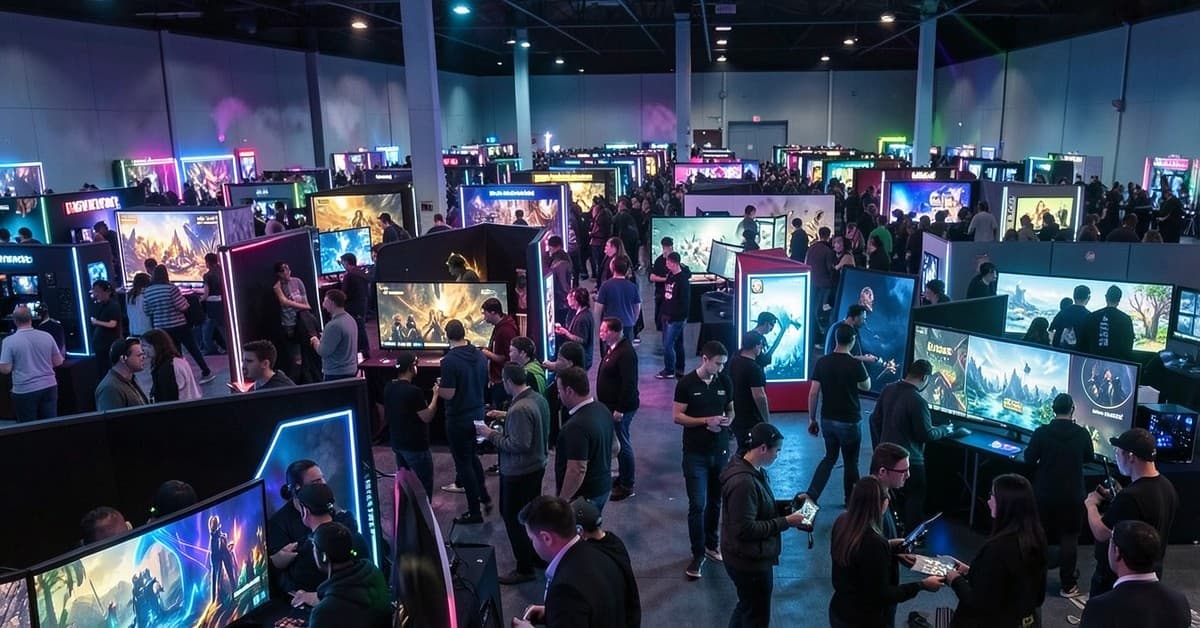
Gamescom, by contrast, never lost it. The German show survived the pandemic and the broader events-industry meltdown in "remarkably good health," partly because it was already in better shape than E3 before COVID arrived. It is well-organized, free of the politics that sank its American rival, and — importantly — open to the public. That public access drives attendance numbers far beyond what E3 ever achieved, creating an atmosphere that feels like a celebration of the medium rather than a trade show for insiders. The energy on the show floor is palpable in a way a Discord server during a livestream can never match.
Code Over Hype: Gamescom's Playable Rebellion
The fundamental difference in philosophy is visible in what each event prioritizes. Summer Game Fest and its June timing serve publishers' PR calendars perfectly for "exciting glimpses of distant prospects" — trailers for games years away. Gamescom, arriving at the end of August, deals in concrete reality. The focus is "playable code, much of it for games releasing in the next two or three months." Journalists and industry professionals go to Cologne to put hands on near-final builds, not to watch cinematic reveals for titles with no release window. For decision-makers evaluating holiday lineups or Q1 prospects, that tangibility is invaluable.
"exciting glimpses of distant prospects"
Summer Game Fest
The shift in publisher focus shows up in the lineup as well. Sony, Microsoft, Nintendo, EA and Activision show up every year at Gamescom, even after many of them left E3 or only pledged limited participation. That steady presence boosts the event's reputation
Gamescom's Where the Deals Happen Now
Perhaps the most striking development is Gamescom's encroachment on Game Developers Conference territory. GDC in San Francisco has long been the industry's primary business-meeting venue, but it has become "increasingly confused as a business venue." A contact at a major publisher, granted anonymity to speak candidly, offered a damning assessment: "Gamescom is now a much nicer and more fruitful place to take meetings than the San Francisco convention." When the people who write the checks and greenlight projects prefer Cologne in August over San Francisco in March, the hierarchy has effectively flipped.
"Gamescom is now a much nicer and more fruitful place to take meetings than the San Francisco convention."
Contact at a major publisher
This preference isn't just about better hotels or shorter lines. It reflects a structural reality: Gamescom concentrates the entire ecosystem — platform holders, publishers, developers, media, and hundreds of thousands of players — in one place at one time. The meetings that happen there benefit from that density. Serendipity still exists in Cologne; you run into a former colleague, a potential partner, or a journalist covering your space. That serendipity is what virtual events and dispersed showcase calendars cannot reproduce, no matter how high the production values.
Why Gamescom 2024 Actually Matters More Than SGF
Internet discourse naturally fixates on the June showcase season. The trailers, the memes, the frame-by-frame analysis of teaser frames — that conversation is loud, immediate, and measurable in views and engagement. But loudness is not importance. The Game Awards in December remains Summer Game Fest's only true rival for "new game debuts," and both events serve the hype machine well. What they don't serve is the industry's need to function as a community of practice.
Gamescom doesn't register on the hype scale the same way. But for the people who actually make, sell, and cover games, it has become "the main attraction." The convention fulfills both halves of a gathering's job: it generates promotional momentum through Opening Night Live and the week's preview coverage, and it gives the industry "a place to meet, to take each others' temperatures, to celebrate a shared passion, and to form an image of themselves that can then be broadcast to the rest of the world." That second half only happens in person. Right now, there's only one place doing it at scale.
The rise of Gamescom isn't a story about one event beating another in a zero-sum contest. It's about the industry recognizing what it actually needs. E3 proved that a trade-only show in Los Angeles could become bloated and politically fragile. Summer Game Fest proved that a virtual showcase series can distribute trailers efficiently but cannot replace physical gathering. Gamescom, by accident or design, struck the balance: public access for scale and energy, industry infrastructure for business, and a late-summer timeline that aligns with playable near-final builds. The hype lives on YouTube. The industry lives in Cologne. See you in Germany.