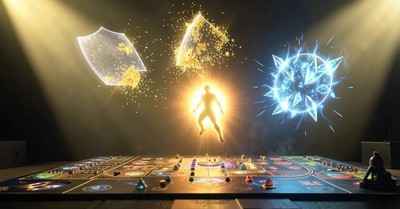

Riftbound, the League of Legends trading card game from Riot Games, closes out its year with the Radiance booster set — the fifth expansion since the TCG launched. The set arrives as a highly anticipated collaboration with Riot Games Music, bringing K/DA into the card pool alongside new mechanics, Legends, and a two-player Showdown kit. For players who have been tracking the meta since the last rotation, Radiance delivers the kind of mechanical shake-up that forces a rethink of battlefield control, while the music crossover pulls in collectors and fans who might never have touched a competitive deck.
The Radiance set is available now across all regions where Riftbound is sold, both in physical booster packs and through the digital client. Riot Games has positioned this as the capstone release for the current competitive season, meaning the cards are legal for tournament play immediately. That matters because three brand-new keywords — Deploy, Show Off, and Disarm — rewrite how gear, hand information, and combat math function on the tabletop. Anyone planning to queue ranked or show up at a local event needs to understand these mechanics before their opponent does.
Three New Keywords Reshape Battlefield Control
Deploy reimagines gear as a battlefield-control tool rather than a unit attachment or base ability. Instead of equipping directly to a unit, Deploy gear sits on a battlefield and creates ongoing effects for whoever controls that location. The Bushwhack Trap gear, for example, lets the player or ally holding its battlefield play an additional hidden card there — normally limited to one per battlefield. This creates a risk-reward layer around movement timing: committing to hold a location pays off with extra hidden-card plays, but overextending leaves the gear vulnerable since simply holding the battlefield removes an opponent's deployed gear. Gear removal is scarce compared to unit removal, so this self-regulating mechanic keeps Deploy from becoming oppressive.
Show Off operates on hand and field transparency. Cards with Show Off let a player reveal a card from hand or choose a friendly card on the field to open up enhanced effects. The spell Rousing Display exemplifies this: reveal a card costing seven or more energy, and the spell summons four token units instead of the base two. The mechanic rewards deckbuilding around high-cost finishers, but it also telegraphs intentions — opponents see the revealed card and can play around the payoff. Disarm completes the trio as a direct combat inversion of Assault: units with Disarm lower an enemy's might on attack rather than boosting their own. This gives aggressive decks a way to shrink opposing threats without committing their own stats to the board, and it pairs naturally with decks that already want to attack frequently.
Evelynn and Seraphine Showdown Decks Offer Divergent Playstyles
The two-player Showdown kit pits Evelynn (Body and Chaos) against Seraphine (Mind and Order), each built to showcase Radiance's new mechanics. The Evelynn deck centers on hiding cards for incremental advantages. Her Legend, Agony's Embrace, draws a card the first time a hidden or facedown card is revealed each turn. The battlefield Bandle Scouts' Academy compounds this by granting a Gold gear token whenever a card is hidden there. Champion unit Evelynn In Control scores an extra point while holding a battlefield with a facedown card. Together, these pieces let the Evelynn player establish board presence quickly while generating resource advantages that offset the rune cost of hiding cards.
Seraphine's deck pursues a go-wide strategy built on exhausted-unit combination. Her Legend, Starry-Eyed Songstress, exhausts herself and three friendly units to reduce a spell's cost by two. Champion unit Seraphine Not Alone spawns a 1-might recruit on play or exhaust and gains +1 might for every other exhausted unit the player controls. The spell High Note gives a unit negative might per exhausted unit the player controls. The combination is real, but the deck suffers from a slower setup — the Show Off emphasis loads the hand with high-energy cards that often sit unplayable on curve while the player floods the board with low-impact tokens. In testing, the Evelynn deck consistently pulled ahead earlier, though both decks have clear competitive potential with tuning.
Meta Deck Integration: Irelia, Azir, and the Ziggs Wildcard
Existing meta decks from the previous set remain viable, and Radiance offers targeted upgrades. Irelia Blade Dancer (Calm/Chaos) continues as a spell-heavy, movement-focused archetype. Satchel Charge slots in naturally — it moves a friendly unit and drops a bomb token on a battlefield, adding a hold-deterrent threat. Hush answers expensive opposing finishers by countering high-cost cards, and Resplendent Rostrum provides a +3 might buff alongside a hand and rune refresh, addressing the deck's occasional resource starvation.
Azir Emperor of the Sands (Calm/Order) runs almost no traditional units, relying on Sand Soldier tokens and equipment combination. Battle Preparations fits perfectly: it grants +2 might, but revealing a gear card via Show Off readies two runes — effectively making the spell free in a gear-dense deck. Command: Attack digs five cards deep for a gear card, though its secondary Deploy interaction is less relevant here. Raucous Anthem offers a potential game-ending push, readying all units and granting +3 might for the turn, which scales with freshly summoned Sand Soldiers.
Then there's Ziggs Hexplosives Expert, a Fury/Chaos Legend whose ability places bomb tokens on any battlefield. Bomb tokens punish opponents for contesting locations — each token deals damage when a player tries to hold, and Explosimian can stack three tokens per hold. With Ziggs Short-Fused adding extra damage per token, a single contested battlefield can threaten nine damage. Deflect units counter this by taxing bomb targeting, but the pressure forces awkward decisions: concede map control or sacrifice board presence. The Fury/Chaos color pair also shares DNA with Draven decks, suggesting cards like Falling Star or Kai'Sa Survivor could bridge the archetypes.
K/DA and HEARTSTEEL Bring Riot's Music Moment to the Tabletop
The Radiance set's music collaboration runs deeper than cosmetic skins. K/DA's new single FIRESTARTER launches alongside the set, and the group appears on special and overnumbered cards alongside HEARTSTEEL. Runes feature instrument-themed art, and a Couture Collection collaboration extends the crossover into physical merchandise. In an IGN interview, Riftbound executive producer Chengran Chai confirmed the team planned this integration early: they "knew Riot as a whole would have a music moment towards the end of the year, so very early on, we said we would lean into that." Game Director Dave Guskin previously acknowledged K/DA's popularity when asked about their inclusion at launch. For a TCG that lives or dies by its ability to attract lapsed League players and music fans alike, this timing is deliberate and effective.
"knew Riot as a whole would have a music moment towards the end of the year, so very early on, we said we would lean into that."
Chengran Chai, Riftbound executive producer
Key Takeaways
- Radiance is the fifth Riftbound booster set and introduces Deploy, Show Off, and Disarm keywords
- Evelynn and Seraphine Showdown decks showcase hidden-card and exhausted-unit strategies respectively
- Mordekaiser and Ziggs Hexplosives Expert join the Legend roster; Ziggs enables bomb-token battlefield control
- K/DA and HEARTSTEEL integration includes special cards, instrument-themed runes, and a Couture Collection
The Bad Gamer Take
Riot Games has just dropped the Radiance booster set, pairing K/DA with Riot Games Music to give the TCG a fresh pop‑culture edge. Riot Games will see a surge in competitive decks because the new Deploy, Show Off, and Disarm mechanics
Radiance feels like a set designed with two audiences in mind: competitive players get three mechanics that deepen battlefield decision-making, while music fans get a gateway product tied to Riot's biggest pop-culture exports. The real test comes over the next few months as the meta settles — whether Deploy gear sees widespread adoption or remains a niche tool, whether Ziggs bomb decks can overcome Deflect tech, and whether the K/DA crossover brings sustained new players or just a temporary collector spike. The cards are on the table. The season starts now.
Sources
I especially like the new Deploy keyword in gear, as it makes for some inconvenient scenarios for your opponent if you can hold the battlefield.
Frequently asked questions
What are the three new mechanics introduced in the Riftbound Radiance booster set?
The three new mechanics introduced in the Radiance booster set are Deploy, Show Off, and Disarm.
How does the Deploy mechanic work with gear like Bushwhack Trap?
Deploy gear focuses on battlefield control, and Bushwhack Trap allows the owner or ally controlling the associated battlefield to play another hidden card there, even though the limit is usually one per battlefield.
What is the Disarm keyword and how does it differ from Assault?
Disarm is the opposite of Assault, where units with Disarm lower an enemy's might on attack rather than empowering their own might.
Which two Legends are featured in the Radiance Showdown Decks two-player starter kit?
The Radiance Showdown Decks feature Evelynn (Body and Chaos) versus Seraphine (Mind and Order).
What are two high-performing meta decks from the previous set that could carry over into the Radiance meta?
Irelia Blade Dancer in Calm and Chaos and Azir Emperor of the Sands in Calm and Order are two high-performing meta decks that could carry over into the Radiance meta.