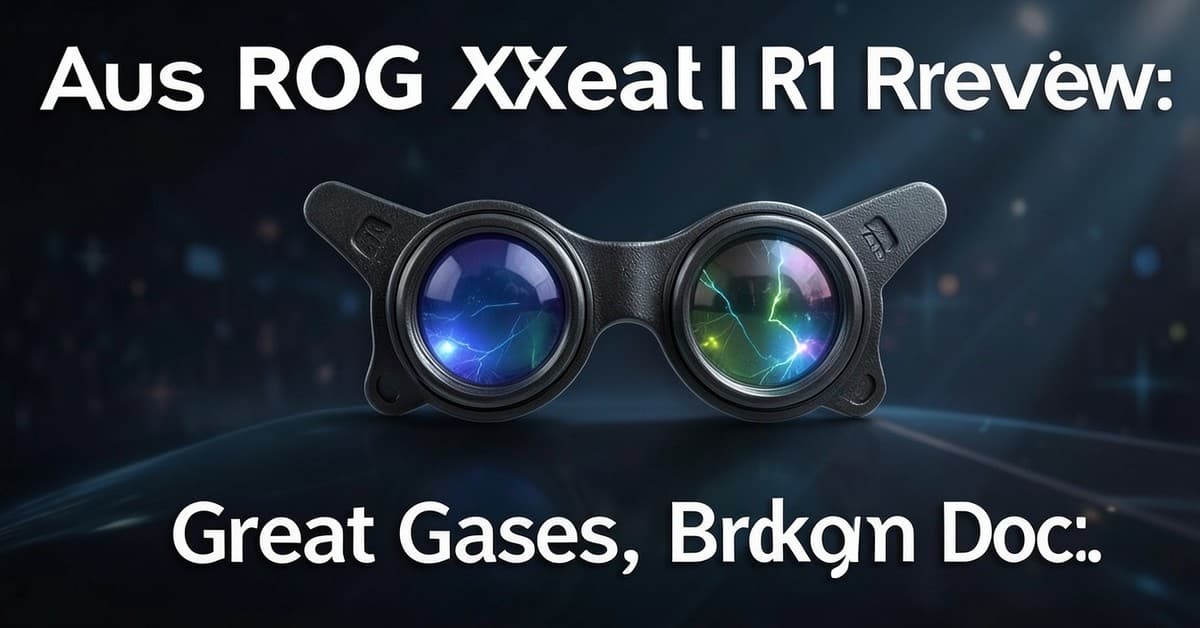
The Asus ROG XReal R1 arrives at a moment when XR glasses are positioning themselves as the natural companion to the handheld PC boom. Pair a Steam Deck or Lenovo Legion Go 2 with a private 171-inch virtual display and you suddenly have a compelling reason to leave the TV behind. Asus teamed up with XReal to build a bespoke pair branded for the ROG ecosystem, and when the glasses connect straight to a handheld they mostly deliver on that promise — sharp image, low latency, and a party trick Instant 3D mode that actually works. The problem is the price: $849 buys you the glasses and a dock you cannot opt out of, and that dock is where the experience falls apart.
Quick Facts — Asus ROG XReal R1
| Developer | Universal Studios Hollywood Hub |
|---|---|
| Score | 6 |
| Price | $849 |
For players who have been eyeing XR glasses as a way to turn a cramped airplane tray table into a personal cinema, the core optics are solid. The 1080p micro-OLED panels run at 120Hz with a claimed 700 nits brightness and 106% sRGB coverage, and in practice colors pop even if the image leans a little washed out and dim — possibly a side effect of the visual profile the review unit refused to leave. Text readability has improved over earlier generations, though stretching the virtual screen to its maximum 171-inch equivalent reveals the pixel structure. The sweet spot is a smaller Follow-mode window that sits comfortably in your field of view without demanding constant head movement.
Design and Features
No XR glasses look subtle, and the ROG XReal R1 leans hard into the gamer aesthetic. The display hood sits about an inch thick, pushing the frames forward on your face, while angular outer lenses give it a sharper silhouette than the Viture Beast. The 3DoF head-tracking camera hides inside a small boxed-off section of the continuous dark front panel, nearly invisible unless you know to look for it. On each temple, nine RGB lighting zones arranged in diagonal lines pulse with a default rainbow cycle that can be customized through the onboard controls — pure ROG theater that you'll either love or toggle off immediately.
Controls live on the left temple: a single button centers the display or opens settings on double-tap, while a rocker behind it cycles through tint, screen size, and volume. The speakers embedded in the temples get loud enough for gameplay but leak sound badly; anyone sitting next to you will hear every spell cast and gunshot, and ambient noise creeps in just as easily. The menu system follows the category tradition of being opaque at first — a couple of hours of fiddling later it clicks, but the learning curve is real. When the glasses plug directly into a handheld like the Xbox Ally X or Lenovo Legion Go 2, the experience is clean: games look great, Final Fantasy XIII's Instant 3D mode transforms the JRPG into a giant 3DS-like spectacle without the usual nausea trigger, and the X1 chip handles the conversion on the fly.
The Dock Drags Everything Down
The included dock is a gemstone-shaped plastic block with angular engravings, two USB-C ports (one powered), two HDMI ports, a DisplayPort, and a front USB-C for the glasses. It adds the ability to plug in a gaming PC, PS5, or other HDMI source — a neat feature that let the reviewer enjoy Beast of Reincarnation on a big virtual screen. But the dock introduces three deal-breakers. First, the visual profile toggle mapped to the control stick's upward push is stuck on "Racing" mode; firmware updates and multiple source devices didn't fix it. Second, the FPS Boost button cranks the refresh rate to 240Hz but introduces a strange shimmer — static pixels wiggle, subtitles become painful to read, and the image feels like it's vibrating. Third, the dock has no RGB lighting, just utilitarian indicator LEDs, which feels like a missed brand beat for a ROG product.
These aren't minor quirks. The 240Hz mode's artifacting isn't present on standard 240Hz monitors, suggesting the upscaling pipeline is the culprit. The stuck profile means you're locked into whatever color calibration "Racing" imposes — potentially explaining the washed-out look. And because the glasses cannot be purchased without the dock, you're paying roughly double the $449 XReal 1S or a $300 premium over the $549 Viture Beast for a accessory that actively degrades the experience when used as intended. That value proposition collapses under scrutiny.
Performance and Gaming
Direct handheld connection remains the star. Plugged into the Xbox Ally X or Legion Go 2, the 1080p/120Hz image holds up beautifully — motion is clean, latency imperceptible, and the Instant 3D mode works as advertised, adding depth to compatible titles without the headache-inducing parallax break of traditional 3D. The 171-inch equivalent size is a marketing number; in practice you'll want the virtual screen smaller and in Follow mode to avoid pixel peeping. Text shimmer persists at the edges, a category-wide limitation of current micro-OLED optics, but it's far less intrusive than on first-gen units.
Docked play is a different story. The base 120Hz image is fine — good enough for Beast of Reincarnation on a desktop GPU — but the moment FPS Boost engages, the shimmer returns and stays until you drop back to 120Hz. The dock's control stick handles Anchor and Follow mode switching cleanly, yet the ergonomics favor the glasses' onboard buttons; peering down at a desk control while wearing a head-mounted display is awkward. Audio leakage remains an issue either way; bring headphones if you value immersion or courtesy.
The Dock That's Dead on Arrival
The dock's broken profile toggle is the headline failure, but the supporting cast of annoyances adds up. The menu system on both glasses and dock demands memorization of non-intuitive stick gestures and button combos. Speakers leak sound in both directions — you hear the room, the room hears your game. The display's washed-out, dim presentation (likely tied to the stuck profile) undermines the 700-nit and 106% sRGB claims. And the Instant 3D mode, a genuine highlight, simply refuses to activate when the glasses run through the dock, stripping away a key differentiator for docked play.
Value is the final nail. At $849, the ROG XReal R1 costs nearly twice the XReal 1S ($449) and $300 more than the Viture Beast ($549), both of which deliver comparable core optics without a mandatory, malfunctioning dock. If you only ever plug into a handheld, the glasses themselves are excellent — but you're forced to subsidize a dock that makes the experience worse. Asus and XReal need to sell the glasses solo, fix the dock's firmware, or drop the price. Until then, the smarter money goes elsewhere.
Pros
- Sharp 1080p/120Hz image with good color when plugged directly into handheld
- Instant 3D mode works well via X1 chip on handheld connection
- Comfortable Follow mode sweet spot avoids pixel structure
- 3DoF head tracking camera well hidden in sleek front panel
Cons
- Mandatory dock adds $400+ over XReal 1S but breaks core features
- Visual profile toggle stuck on "Racing" mode despite firmware updates
- 240Hz FPS Boost introduces shimmer artifact that causes headaches
- Instant 3D mode disabled when using dock
- Speakers leak sound badly; no audio isolation
- Steep learning curve for menu controls on both glasses and dock