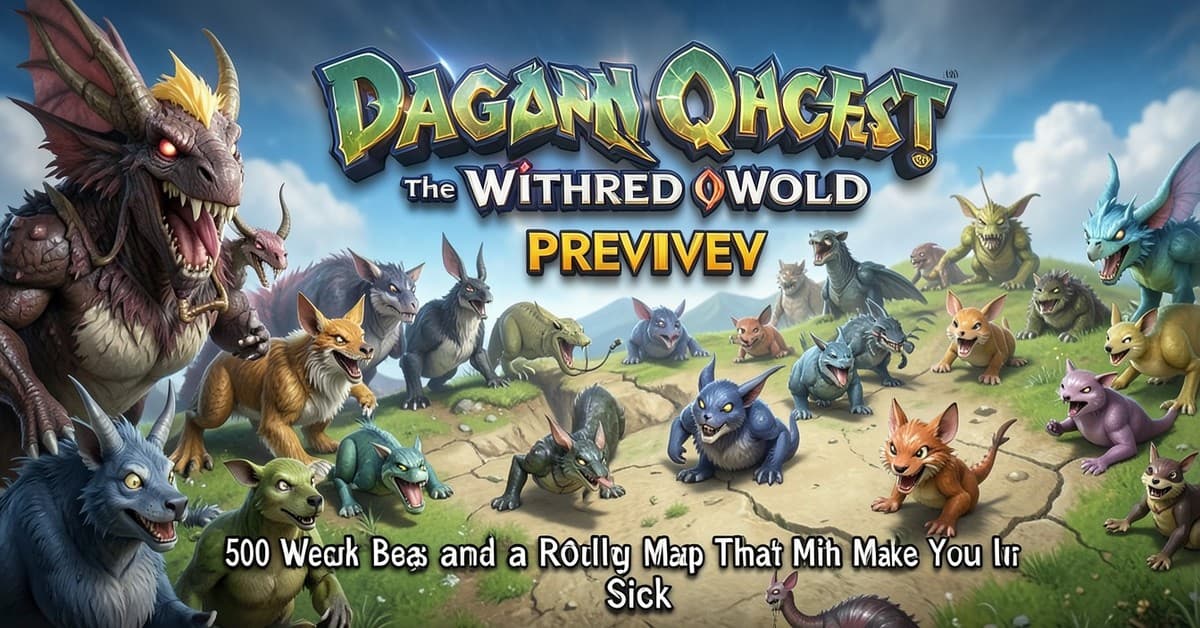
Dragon Quest Monsters: The Withered World landed at PAX West 2026 with a staggering promise: over 500 monsters to collect, fuse, and unleash in turn-based battles across the decaying world of Witherwood. Square Enix's long-running sub-series has always leaned harder into charm and weirdness than its mainline counterparts, and this sequel doubles down on both. For players who have spent decades recruiting Slimes and Metal King Slimes, the sheer roster size signals a collectathon that could consume hundreds of hours — if the exploration doesn't make you queasy first.
The preview build let journalists explore two distinct zones: the desert surrounding Witherrealm's core kingdom and a tropical island teeming with high-level threats. Bianca and Nera, the dual protagonists returning from Dragon Quest V, each bring unique party perks that fundamentally shape how you build your team. Bianca favors dragon and beast types with a brawler playstyle that keeps HP topped off, while Nera runs a glass-cannon setup that restores MP after battles and resurrects fallen allies. That asymmetry creates genuine replay value — your monster recruitment priorities shift dramatically depending on which heroine you pick.
Here's a thinking process:
Developed and published by Square Enix, Dragon Quest Monsters: The Withered World continues the monster-collecting RPG sub-series that began in 1998. The premise centers on Bianca and Nera journeying to the Witherwood world to find a cure for their fathers' mysterious illness, wielding a magical watering tool to restore sacred trees across decaying lands. The legendary Akira Toriyama's art style infuses every creature and environment with expressive, colorful personality — a visual signature that instantly distinguishes the series from competitors like Pokemon.
For genre veterans, the hook is straightforward: a vast roster of 500-plus monsters, a synthesis system that merges existing creatures into new hybrids, and the series' signature blend of lighthearted storytelling and strategic depth. Newcomers should know this leans more accessible than mainline Dragon Quest titles — auto-battle handles grunt work, and scouting monsters mid-fight streamlines the collection loop.
Here's a thinking process:
Combat follows the familiar turn-based formula: your monster wrangler issues commands, uses items, or activates auto-battle to let the AI handle routine encounters. The twist lies in party composition — you field up to four mid-sized monsters, but larger beasts consume multiple slots, forcing tactical decisions between quantity and raw power. This slot system interacts directly with your chosen protagonist's perks; Bianca's HP sustain favors bulky tanks, while Nera's MP regeneration enables spell-heavy glass cannons.
Scouting remains the primary recruitment method. Weaken a monster enough, or overpower it significantly, and you can recruit it mid-battle — ending the fight instantly and adding the creature to your roster. The synthesis system then lets you fuse monsters into entirely new species. During the preview, combining a Bantamweight rooster with a Platypunk produced a Bullfinch, a powered-up beast that immediately strengthened the party. With over 500 base monsters plus synthesis variants like the tropical Coconut Slime, the combinatorial possibilities are staggering.
"I was blown away by how much variety there was in the selection of monsters."
That variety extends beyond raw numbers. Each monster carries distinct visual flair — Toriyama's influence makes even palette-swapped variants feel like deliberate designs rather than lazy asset reuse. The tropical island zone showcased this particularly well, with high-level monsters roaming freely and creating natural difficulty spikes that encourage preparation over grinding.
Here's a thinking process:
The rolling world map represents the boldest visual departure. Instead of a traditional overhead view, exploration unfolds on a stylized, curved map that rotates and undulates as you move. It looks striking in screenshots — a storybook come to life — but the motion introduced a significant accessibility concern. Multiple preview attendees reported motion sickness during world exploration, with the rolling perspective triggering discomfort that didn't occur during standard battles or menu navigation.
Square Enix anticipated this. The accessibility menu includes camera and visual effect adjustments specifically designed to mitigate motion sickness during exploration. Players sensitive to camera movement should toggle these options immediately upon starting. Beyond the map, the Toriyama art style shines: monster animations brim with personality, spell effects pop with vibrant color, and the two preview zones — arid desert and lush tropics — establish a world worth saving. Frame rate held steady during the hands-on session, though final performance across platforms remains unconfirmed.
Here's a thinking process:
The motion sickness issue is the preview's most concrete criticism, and it's not a minor nitpick. For affected players, the core exploration loop — traversing zones, discovering monsters, uncovering secrets — becomes physically uncomfortable. While accessibility options exist, their effectiveness varies by individual; some players may still struggle even with reduced camera motion. This is a known risk with curved-world perspectives, and it's disappointing that such a fundamental traversal mechanic introduces a barrier for a subset of the audience.
Beyond that, the preview build didn't reveal enough of the synthesis depth to judge whether the system offers meaningful strategic choices or simply inflates the monster count with marginal upgrades. The Bantamweight-plus-Platypunk example produced a stronger monster, but whether synthesis enables build-defining combinations or just bigger numbers remains unclear. Similarly, the narrative's emotional beats — saving parents, restoring a dying world — were only glimpsed in the opening hours. Whether the story sustains its charm across a full campaign is an open question.
Dragon Quest Monsters: The Withered World is shaping up to be another solid and charming entry in the sub-series. The monster-collecting RPG market is crowded, but Square Enix's commitment to the franchise's particular blend of wholesomeness and weirdness keeps this series distinct. With 500-plus monsters, dual protagonists who meaningfully alter team building, and a synthesis system that encourages experimentation, there's enormous potential here — provided the rolling map doesn't leave you reaching for a bucket. For fans of the series, this looks like the most expansive entry yet. For newcomers, it's an accessible entry point with a unique personality all its own.
Pros
- Over 500 collectible monsters with expressive Toriyama designs
- Dual protagonists with distinct perks that change party-building strategy
- Monster synthesis system creates hybrid creatures beyond the base roster
- Accessibility options address motion sickness concerns
Cons
- Rolling world map triggers motion sickness for some players
- Synthesis depth and strategic impact unproven in preview build
- Narrative longevity uncertain beyond opening hours
Dragon Quest Monsters: The Withered World launches with a clear identity: the weirdest, most expansive monster collector in the series' history. Whether that's enough to stand out in a genre dominated by Pokemon comes down to how much you value charm over competition — and whether your stomach can handle the ride.