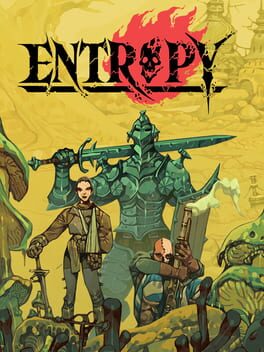
The developers behind Dread Delusion have released their follow-up project Entropy into early access on Steam, and it represents a sharp pivot from their previous work. Where Dread Delusion channeled first-person classics like King's Field and The Elder Scrolls, Entropy adopts a JRPG-inflected perspective reminiscent of Final Fantasy 10 or Lost Odyssey while layering tactical depth that feels distinctly PC-centric. Lead developer James Wragg describes the project as his personal take on Fallout in the same way Dread Delusion was his take on The Elder Scrolls, and that lineage is visible in every system from combat to worldbuilding.
Quick Facts — Entropy
| Developer | Dread Delusion developers (James Wragg's team) |
|---|---|
| Platform(s) | PC |
| Release Date | Early access available now on Steam |
| Genre | JRPG, Tactical RPG, Post-apocalyptic RPG |
For players who have been waiting for a tactical RPG that treats tabletop mechanics as more than a cosmetic skin, Entropy arrives at a compelling moment. The game combines a large party size for tactical battles with permadeath stakes, a locational damage system that echoes Fallout 1's called shots, and a reactivity framework that promises meaningful storytelling consequences. A substantial free demo is available alongside the early access release, letting curious players test the waters before committing to the full experience.
What We Played
The early access build and demo showcase Entropy's opening hours, introducing its desolate post-apocalyptic setting and core combat loop. The world presents a tone that Wragg describes as rhyming with Fallout 1 — desolate and in-your-face, with what little levity exists feeling like a remnant of the pre-collapse world. The opening scene centers on a play, a detail that immediately signals the game's interest in performance and memory as thematic anchors. Combat encounters demonstrate the tactical layer: players can target specific limbs or zones on enemies by accepting an accuracy penalty, trading precision for the chance to disarm a heavily armed foe or exploit a mutated enemy's bulbous weakpoint in a manner reminiscent of Resident Evil's design language.
The demo also reveals a party system that supports a larger roster than typical JRPGs, enabling squad-level tactics rather than the standard three-character front line. Permadeath looms over every engagement, raising the stakes of each locational damage decision. The low-fi visual style — a deliberate choice rather than a budget constraint — allows the team to implement a wide variety of weapons and status effects without the animation and asset burden that would accompany higher-fidelity graphics. This technical approach directly serves the design goal of tabletop-like variety.
Gameplay Impressions
The locational damage system stands out as the most immediate translation of Fallout 1's legacy into Entropy's tactical framework. By allowing players to incur accuracy penalties to target specific body parts — disarming enemies, crippling movement, or hitting vulnerable mutations — the system creates micro-decisions inside every turn that reward enemy knowledge and positional awareness. Wragg notes that advanced battles will lean heavily on this: identifying which foe carries the dangerous weapon, which mutation presents a targetable weakpoint, and allocating limited action economy to exploit them. For players who enjoyed the called-shot calculus of the original Fallout, this feels like a direct spiritual successor mechanic adapted for party-based tactics.
Mordheim's influence manifests most clearly in the character customization philosophy. Wragg explains that tabletop's freedom — where developers never have to code graphics for every weapon swing — inspired Entropy's approach to loadout variety. The low-fi art style becomes an enabler here: the team can add unique weapons, status effects, and build-defining gear without each addition requiring bespoke animation rigs or seamless blending with existing assets. "I think if we were working in more high fidelity, we would have had to rein in that ambition a bit," Wragg said. The result is a game where a character's equipment screen reads more like a Mordheim warband roster than a standard JRPG inventory, with each piece carrying distinct mechanical weight rather than just stat increments.
"In many ways, if Dread Delusion was my take on The Elder Scrolls, then this is my take on Fallout. The original Fallout, Fallout 1, is one of my favorite games, and we're riffing on that quite a lot with Entropy."
Wragg's comparison frames Entropy's ambition clearly: just as Dread Delusion deconstructed first-person RPG conventions to build something personal, Entropy uses Fallout 1's systemic DNA — called shots, reactive world, desolate tone — as a foundation for a party-based tactical experience. The JRPG presentation (turn order visualization, character portraits, narrative pacing) provides accessibility, but the underlying math and possibility space owe more to PC CRPGs and tabletop wargames. This hybrid identity is the game's most compelling hook.
"What I love about tabletop is, it's just pen and paper. You can house rule stuff as much as you want, so we've got a bunch of custom rules in our [Mordheim] campaign. It really encourages creativity because you make your little guys and you customize them based on how you load out your character."
The house-rule mentality extends beyond character building into Entropy's design philosophy. Wragg's research into tabletop history — tracing how Dungeons & Dragons and its spin-offs seeded systems that persist in modern AAA RPGs — informs a development approach that asks "why" before implementing any mechanic. This archaeological mindset means Entropy's systems aren't borrowed from recent genre hits but excavated from their origins. For players, this translates to mechanics that feel intentional rather than imitative: permadeath isn't a roguelike trend chase but a consequence of tactical transparency; reactivity isn't a branching narrative flowchart but a simulation of faction and world state responding to player action.
What We Still Don't Know
Several critical questions remain unanswered by the early access build. The full scope of the reactivity and storytelling systems — described as feeling more PC gaming than PS2 gaming — hasn't been demonstrated beyond the opening hours. How deeply do choices cascade? Can faction relationships be irreparably broken? Does the narrative structure support multiple distinct playthroughs, or does it funnel toward a fixed endpoint? The demo and early access content show promise but haven't stress-tested these promises across a full campaign.
Long-term progression balance also remains opaque. With permadeath, large party sizes, and extensive customization, the difficulty curve and pacing of character advancement will determine whether Entropy respects player time or demands masochistic repetition. Wragg mentioned the team's love for sidequests expanded the word count beyond original plans, suggesting a substantial campaign, but early access players will effectively be stress-testing the economy of death and recovery. The final release's save system, difficulty options, and potential ironman toggles could dramatically shift the audience this game serves.
The Tabletop Philosophy
Wragg's design philosophy — that RPG developers must return to tabletop roots to understand the systems they're inheriting — positions Entropy as something rarer than a genre exercise. "If you're designing an RPG, you have to go back to the source on tabletop games because so many of the systems that exist within modern AAA RPGs, they originated with Dungeons & Dragons and all those other spin-off games and war games," he said. This isn't nostalgia; it's architectural literacy. By studying Mordheim's unit customization, Fallout 1's called shots, and the lineage connecting both to D&D's wargaming ancestry, Wragg's team has built a game that understands why its mechanics exist, not just how they function.
For the player, this literacy translates to a game where systems interlock with intentionality. The locational damage feeds into permadeath stakes; the low-fi graphics enable the weapon variety that makes loadout decisions meaningful; the JRPG presentation makes the tactical depth legible without flattening it. Entropy doesn't feel like a pastiche of influences — it feels like a developer who did the reading and built something that honors its sources by extending them. Whether the full campaign delivers on the early promise remains to be seen, but the foundation is unusually thoughtful for an early access tactical RPG.
Key Takeaways
- Entropy is the new early access RPG from the developers of Dread Delusion, available now on Steam with a free demo
- Lead developer James Wragg cites Fallout 1 and the 1999 Warhammer spinoff Mordheim as primary design inspirations
- Features include large party tactical battles, permadeath, locational damage targeting, and deep character customization
- Low-fi graphics deliberately enable high weapon and status effect variety without high-fidelity animation costs