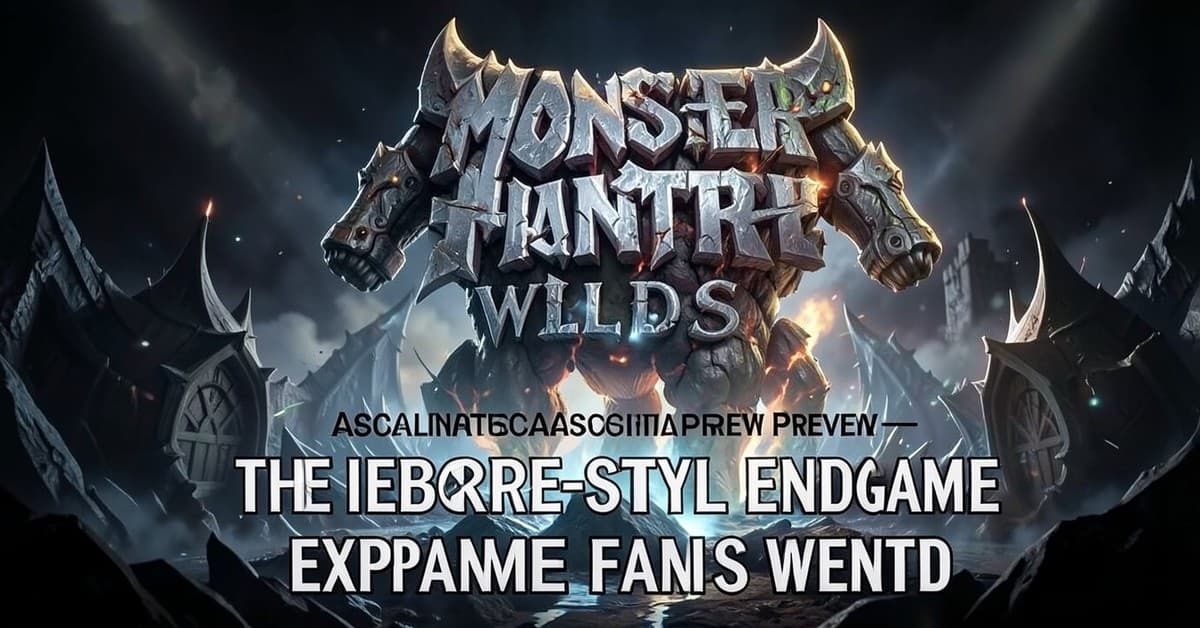
Capcom's Monster Hunter Wilds: Ascendance expansion arrives in 2027 for PS5 and PC, and based on IGN's hands-on demo at Tokyo Game Show 2026, it might be the course correction the series needed. The base game launched with stunning visuals and seamless open zones, but its endgame evaporated quickly — hunts lacked the aspirational wall that turns a good action RPG into a hundred-hour obsession. Ascendance appears built specifically to fix that, layering Master Rank difficulty, a new Boost Drivers system, and monsters that hit like freight trains onto the existing foundation. For players who put down Wilds after clearing the story, this expansion is the reason to come back.
Quick Facts — Monster Hunter Wilds: Ascendance
| Platform(s) | PS5, PC |
|---|---|
| Release Date | 2027 |
| Genre | Action RPG |
The preview, written by IGN contributor Justin Koreis, pulls no punches about the base game's shortcomings.
"The endgame of Monster Hunter Wilds was too easy, but this might be what Monster Hunter sickos are looking for."
Justin Koreis, IGN Contributor
That phrasing — "sickos" as a term of endearment for the hardcore subset that optimizes builds, memorizes hitboxes, and chases sub-seven-minute clears — signals exactly who Ascendance is for. This isn't a casual-friendly appendage; it's a deliberate pivot toward the Iceborne model where the real game begins after the credits roll.
Here's a thinking process:
The centerpiece mechanical addition is the Boost Drivers system, powered by a Boost Gauge that accumulates up to three charges over time and through offensive pressure. Activating Boost transforms every weapon's moveset in distinct ways — not a universal buff, but a tailored expansion of each weapon's identity. For Dual Blades, Boost open ups ultra-rapid attacks, converts dodges into damage-dealing acrobatics, and critically, grants the weapon its first true offset attacks: counters that stagger incoming hits and nullify damage entirely. That last part changes the risk calculus of aggressive play completely. A Dual Blades hunter no longer needs to commit to a dodge-read on a dive-bombing Alpha Arakata; they can meet it head-on and punish the recovery.
Sword and Shield receives an equally significant toolkit. Boost adds a ranged grapple move reminiscent of the Clutch Claw from Monster Hunter World: Iceborne, the ability to coat blades with items for elemental damage or self-healing, and new combo enders like the Spinning Reaper — a high-damage backhand rotation that turns a defensive block into a punish window. The preview notes that boosted attacks are highlighted in red font with a distinct icon, and a locking sound effect signals readiness. These UI touches matter: in a fight against Teostra where you're juggling fireblight, blastblight, and tail swipes, cognitive load is already maxed. Clear feedback lets you execute the Boost window without menu-diving or guesswork.
Here's a thinking process:
The demo's first hunt pits players against Alpha Arakata, an all-new winged monster, in the Eyrie — a new region of the Forbidden Lands defined by floating rock layers and spiraling root bridges that evoke the vertical grandeur of Coral Highlands from Monster Hunter World. The Seikret mount gains meaningful upgrades here: it can now flap for sustained altitude, tuck wings for rapid acceleration, and deal with the Eyrie's aerial lanes with genuine agility. Chasing a fleeing Arakata across these layers isn't just traversal; it's an extension of the hunt where positioning and mount control determine whether you catch the monster before it recovers.
Arakata's design emphasizes aerial dominance. On the ground it slams bone-plated wings and head with heavy, telegraphed arcs. In the air it circles beyond melee range, then launches missile-speed dives with minimal warning. The preview describes a phase where it chains dive-bombs and summons its flock for a formation strike — a multi-vector attack that demands spatial awareness, not just reflex. The 20-minute hunt timer (a series staple returning in Master Rank) adds pressure: every second spent sheathing to heal or reposition is a second closer to failure. Koreis notes the fight had his "build-crafting gears turning," which is the highest compliment a Monster Hunter preview can pay. A monster that forces theorycrafting before you've even killed it once is doing its job.
Here's a thinking process:
The second demo hunt brings back Teostra, the lion-headed Elder Dragon, in the Oilwell Basin. This is a deliberate benchmark: Teostra has been a series constant since Monster Hunter 2, and its patterns are etched into veteran muscle memory. Fighting it with Sword and Shield (and Bow as a backup) reveals how Ascendance's changes interact with a known quantity. Teostra's relentless aggression — flame aura, blastblight application, tail swipes that chain into charges — forces constant shield management. Koreis describes losing "too much potential offense to the time spent with my shield up," and the hunt ends in a time-out after 20 minutes. Neither hunter nor monster fell.
That time-out is telling. In the base game, a 20-minute limit was rarely a factor; most hunts ended in eight to twelve minutes. A time-out against a familiar Elder Dragon suggests Master Rank health pools, damage thresholds, and AI aggression have been tuned upward significantly. The preview's observation that Boost's grapple and coating mechanics help but don't trivialize the fight indicates the difficulty curve respects player skill expression. You can't Boost your way out of bad positioning against Teostra; the system amplifies good play, it doesn't replace it.
Weapon Moveset Expansions Across the Arsenal
Beyond the two weapons demonstrated, the preview confirms every weapon receives expanded movesets tied to Boost. This is the Iceborne comparison in action: that expansion added the Clutch Claw, slinger burst upgrades, and weapon-specific mechanics that fundamentally altered high-level play. Ascendance appears to be taking the same approach — systemic depth over content volume. The Dual Blades' Demon Flurry combo becomes a screen-clearing finisher under Boost, ending in massive vertical slashes. Sword and Shield gains Falling Bash variants that spiral from mid-air. Fourteen other weapons await their Boost reveals, and the combinatorial space of armor set bonuses, deco slots, and Boost-specific synergies is already sparking theorycrafting.
The Seikret enhancements — flapping, tucking, accelerated gliding — also apply universally. In a game where map traversal was already streamlined, these upgrades matter most in vertical zones like the Eyrie and during monster chases across zone boundaries. They're quality-of-life on paper, but in practice they compress the downtime between engagements, keeping the action loop tight.
What This Means for the 2027 Launch
Ascendance launches sometime in 2027, a two-year gap from Wilds' 2025 release that mirrors the World-to-Iceborne cadence. The preview's verdict is unambiguous:
"This seems every bit the Monster Hunter World: Iceborne-style expansion I'd been hoping for."
Justin Koreis, IGN Contributor
That's not a guarantee — demos are curated vertical slices, and endgame longevity lives or dies by post-launch support, event quest cadence, and the depth of the Master Rank armor/weapon trees. But the mechanical foundation shown at Tokyo Game Show 2026 addresses the base game's core criticism directly. The aspirational challenge is back. The build-crafting puzzle has new variables. The monsters hit hard enough to demand mastery.
For the player who cleared Wilds in fifty hours and walked away satisfied but hungry, Ascendance looks like the second helping they ordered. For the player who bounced off Wilds because the endgame felt like a victory lap, this expansion might be the reason to reinstall. Either way, the "sickos" have their work cut out for them — and that's exactly how they like it.
Sources
holy smokes, what a difference two years makes
| Tier | Requirement |
|---|---|
| ultra | rapid attacks, converts dodges into damage-dealing acrobatics, and critically, grants the weapon its first true offset a |
| high | damage backhand rotation that turns a defensive block into a punish window |