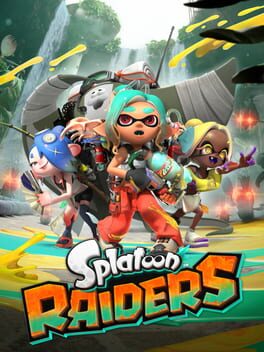
Nintendo will release Splatoon Raiders on July 23 for both Switch and Switch 2, marking the franchise's first foray into the player-versus-environment looter-shooter space. The spinoff takes the ink-based turf war mechanics that defined the 30-million-selling series and transplants them into a cooperative campaign structure more commonly associated with games like Borderlands and Diablo. For a company that has spent the last decade refining its most reliable formulas, this represents a genuine departure — the kind Nintendo hasn't attempted since the original Splatoon turned competitive multiplayer on its head in 2015.
Quick Facts — Splatoon Raiders
| Developer | Nintendo |
|---|---|
| Platform(s) | Switch, Switch 2 |
| Release Date | July 23 |
| Genre | looter-shooter, player-versus-environment |
The release arrives at a moment when Nintendo's output has felt increasingly comfortable. The company's quality control remains impregnable and its franchises timeless, but creative comfort carries its own risks. Splatoon Raiders matters because it demonstrates what happens when Nintendo applies its pop aesthetic, playful sensibility, and design nous to a genre it has never touched before. Early reviews have compared the result to a kind of Destiny lite, suggesting the familiar loot-chase loop feels fresh when filtered through Splatoon's distinctive ink-swimming movement and territory-control DNA.
Splatoon Raiders’ Awkward Innovation
Splatoon Raiders comes from Nintendo's internal development teams, the same group that conceived the original Splatoon as a project driven by a younger generation of designers. The game launches simultaneously on Switch and Switch 2 on July 23, positioning it as one of the first major cross-generational releases for Nintendo's new hardware. As a spinoff rather than a numbered sequel, Raiders recontextualizes the franchise's core mechanics — ink coverage as territory control, squid-form traversal, weapon variety tied to playstyle — within a PvE campaign built around loot progression and cooperative play.
The original Splatoon debuted on Wii U in 2015 and became Nintendo's most exciting new franchise in 15 years, eventually selling 30 million copies across its entries. It succeeded by taking note of trends in the broader gaming culture — competitive shooters, fashion customization, music-driven identity — and reframing them in a uniquely Nintendo way. Raiders attempts a similar trick with the looter-shooter genre, which has been dominated for years by Borderlands, Diablo, and Destiny. Nintendo has never previously released a game in this space, making Raiders a genuine test of whether the company's design philosophy can revitalize an oversubscribed category.
<strong>Nintendo's $50 Experiment Nobody Saw Coming</strong>
The core innovation of Splatoon Raiders lies in how it maps the franchise's distinctive mechanics onto looter-shooter conventions. Ink coverage — traditionally a scoring metric in competitive matches — becomes a progression tool in PvE encounters, where painting territory open ups paths, reveals secrets, and powers up abilities. The squid-form swimming that lets players traverse their own ink at high speed translates into a movement system built for horde encounters and vertical exploration rather than flag capture. Weapon classes map to familiar looter archetypes: rapid-fire shooters behave like assault rifles, chargers function as sniper equivalents, and rollers occupy the heavy-melee niche.
For players, this means the moment-to-moment feel of Splatoon survives the genre shift intact. The satisfaction of swimming through your own color at full speed, the tactical decision of when to submerge versus when to shoot, the read of enemy ink as both threat and opportunity — all of it carries over. But the context changes: instead of a three-minute turf war against human opponents, you're managing cooldowns, chasing gear drops, and coordinating builds with teammates across a campaign that Polygon's reviewers have likened to a streamlined Destiny experience. The loop should feel familiar to genre veterans, but the movement and spatial awareness Splatoon demands add a layer of physicality most looter-shooters lack.
Splatoon’s Music Outshines the Gameplay
Nintendo's commitment to Splatoon's in-universe music culture continues with Raiders. The Nintendo Music app features a special release sampler from the game's soundtrack, highlighted this week by the track "Escarpment Torment / DHA." The piece builds around a delirious, sawing cello line that spirals over juddering, stuttering arthouse techno — an avant-garde direction that stands out even within Nintendo's increasingly eclectic music library. This isn't background audio; Splatoon's fictional bands and idols have always been central to the franchise's identity, and Raiders appears to double down on that commitment.
The visual aesthetic follows a similar logic. Where Borderlands leans into cel-shaded comic exaggeration and Diablo embraces gothic darkness, Splatoon Raiders applies the franchise's pop sensibility — bright colors, fashion-forward character design, street-culture energy — to dungeon-crawling environments. The result is a looter-shooter that doesn't look like its peers. For players tired of the genre's visual homogeneity, that distinction matters: the world feels like a place you'd want to inhabit, not just a series of arenas to clear for better numbers on a stat sheet.
Splatoon's Biggest Flaw Finally Exposed
Splatoon Raiders represents a low-risk, high-reward proposition for Nintendo. The spinoff format insulates the mainline series from experimental baggage while giving the development team room to test ideas that might eventually feed back into a hypothetical Splatoon 4. For players, the game offers a rare thing: a looter-shooter where movement skill matters as much as build optimization. The ink-swimming mechanic introduces a spatial dimension that changes how you approach encounters — positioning isn't just about cover, it's about painting the paths you'll need to escape, flank, or pursue.
The broader significance extends beyond this single release. Nintendo needs more Splatoons — more franchises born from looking outward at what the rest of the industry is doing and asking what a Nintendo version looks like. A Nintendo roguelike. A Nintendo friendslop game. A Nintendo extraction shooter. The company has the resources, the talent, and the platform to make each of those interesting in ways no other studio could replicate. Splatoon Raiders proves the instinct remains. The question is whether Nintendo will make a habit of following it.
Key Takeaways
- Splatoon Raiders releases July 23 for Switch and Switch 2 as a PvE looter-shooter spinoff
- The game adapts Splatoon's ink mechanics and squid-form movement to a cooperative campaign structure
- Reviews compare the experience to Borderlands, Diablo, and a streamlined Destiny
- The soundtrack's "Escarpment Torment / DHA" track features avant-garde cello over arthouse techno
Nintendo's next opportunity to step outside its comfort zone may already be in development — the company's history suggests its most interesting work comes when younger designers get room to reinterpret genres the mainstream has settled. Splatoon Raiders won't rewrite the looter-shooter rulebook, but it reminds us that Nintendo's best ideas still come from refusing to stay in its lane. The 30-million-selling franchise that started as an improbable experiment on Wii U has become the proof of concept for a bolder Nintendo. Whether the company builds on that proof or files it away remains the most interesting story in its immediate future.