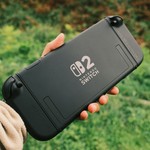
SanDisk's officially licensed SanDisk MicroSD Express card for Nintendo Switch 2 arrives as the fastest microSD Express option on the market for raw throughput, yet the real-world benefits shrink dramatically once games are actually running. The card hits sequential read speeds up to 880 MB/s and write speeds up to 650 MB/s on paper, and in a week of testing it outperformed the Samsung P9 Express in almost every benchmark. For players who constantly shuffle games between internal storage and the card, those transfer savings add up — Mario Kart World wrote in roughly four minutes versus over seven on a competing PNY card. But load times tell a different story: Donkey Kong Bananza, Mario Kart World, and Tears of the Kingdom all load within fractions of a second of cheaper rivals, making the premium price difficult to justify for anyone who isn't moving large files daily.
Quick Facts — SanDisk MicroSD Express
| Publisher | SanDisk |
|---|---|
| Platform(s) | Nintendo Switch 2 |
| Score | 8 |
The main point of this release is straightforward: microSD Express cards jump far beyond the older microSD format that still powers most handhelds, and the ceiling for true gameplay speed feels already topped out. SanDisk shows its card can write data faster than rivals, yet the console's architecture seems to cap read rates and loading times long before the storage device becomes the weak link. So customers pay a premium for speed that rarely translates into noticeable gains while playing. The real question is how frequently you plan to move 20‑plus‑gigabyte titles in and out of the system, because that will dictate whether the extra cost is worth it.
What Is SanDisk MicroSD Express?
SanDisk's officially licensed microSD Express card targets the Nintendo Switch 2 exclusively, carrying the console maker's branding and a spec sheet built around the new Express interface. The card comes in three capacities — 256GB, 512GB, and 1TB — with the 512GB model emerging as the practical sweet spot when paired with the Switch 2's 256GB of internal storage, yielding three-quarters of a terabyte total. SanDisk positions this as the premium option in a category that already includes Samsung's P9 Express, PNY's microSD Express card, and Walmart's budget Onn brand, all of which undercut SanDisk on price while delivering comparable real-world load performance.
The licensing partnership with Nintendo signals quality assurance, but it also carries a price premium that the benchmarks struggle to validate for typical use cases. Sequential read and write ratings of 880 MB/s and 650 MB/s respectively look impressive on packaging, yet those figures represent ideal sequential throughput that rarely materializes during the random, small-file transfers that define game installations. The PNY card actually claims higher rated speeds at 890 MB/s read and 750 MB/s write, yet SanDisk's card consistently outperformed it in write-heavy scenarios. This disconnect between marketed specs and measured reality runs through the entire microSD Express category, and SanDisk's entry does not escape it.
Gameplay and Mechanics
Transfer performance is where SanDisk's card earns its keep. Writing Mario Kart World (22GB) to the card averaged 94 MB/s, while reading it back to internal storage dropped to 91 MB/s — a pattern that repeated across every title tested. Resident Evil 4 wrote at 105 MB/s but read back at only 80 MB/s. Super Smash Bros. managed 95 MB/s writes and 85 MB/s reads. The smallest test file, Donkey Kong Bananza at 8.9GB, peaked at 122 MB/s writing to the card and 88 MB/s reading back. These numbers translate to tangible time savings: Mario Kart World took roughly four minutes to write versus over seven minutes on the PNY card, a difference that compounds across a library of large games.
The asymmetry between write and read speeds on the console itself is notable — the card consistently writes faster than it reads when paired with the Switch 2, suggesting the console's controller or firmware imposes a read-side bottleneck. Samsung's P9 Express actually edged out SanDisk on a single Resident Evil 4 read test at 96 MB/s, but otherwise trailed by 1–12 MB/s across the board. PNY's card matched reads closely but delivered roughly half the write throughput of SanDisk's option. For a player who installs a game once and plays it for months, these transfer differences are irrelevant. For someone managing a rotating library across limited internal storage, the minutes saved per large title become meaningful.
Visuals, Audio, and Performance
Load times are the great equalizer. Donkey Kong Bananza reached its title screen in 21 seconds flat — identical to both the PNY and Samsung cards. Mario Kart World averaged 19.4 seconds, a tenth of a second behind PNY and roughly two seconds faster than Samsung. Tears of the Kingdom loaded in 8.5 seconds, nearly a full second quicker than either competitor. These margins are imperceptible in practice, and all three cards trail the Switch 2's internal storage by only fractions of a second on most titles. The console's internal NVMe storage remains the fastest option, but the gap has narrowed to the point of irrelevance for everyday play.
This convergence suggests the Switch 2's memory controller, game engine optimization, or OS-level I/O scheduling caps load performance well below what any current microSD Express card can deliver. SanDisk's card is demonstrably faster at moving data to and from the media, but that advantage evaporates once the game is running. The practical implication is clear: buy the cheapest reputable microSD Express card that meets your capacity needs unless you have a specific workflow demanding maximum transfer throughput. The Samsung P9 Express and Walmart's Onn brand both deliver effectively identical gameplay experiences for less money.
What Doesn't Work
The price premium is the most immediate drawback. SanDisk's officially licensed card costs more than both the PNY and Onn alternatives, yet the load-time parity means most buyers are paying for transfer speed they'll rarely use. The marketed sequential speeds (880/650 MB/s) bear little resemblance to the random read/write performance that actually governs game transfers, a problem across the category but especially noticeable when the premium product's box highlights numbers the console can't realize. Read speeds consistently lag behind write speeds in console-to-card operations, an asymmetry the documentation doesn't explain and the average user won't expect.
Internal storage still edges out for load times, although the gap amounts to a mere fraction of a second on most titles. That advantage stays consistent across every microSD Express card, regardless of brand, and is simply a platform quirk, not a flaw unique to SanDisk. The real problem is that SanDisk’s offering doesn’t outperform cheaper rivals in the areas that matter most—launch speed, the instant feel of picking up a game. The “officially licensed” stamp guarantees the card will work and meets quality standards, but it never open ups more speed than what the console’s own hardware can squeeze out. If you’re chasing the absolute fastest boot, the internal drive still wins marginally, but for everyday play the difference is almost invisible.
Pros
- Fastest write throughput among tested microSD Express cards for Switch 2
- Saves real time when transferring large games on and off the console
- Officially licensed with Nintendo quality assurance
- 512GB capacity pairs well with 256GB internal storage
Cons
- Higher price than PNY and Walmart Onn alternatives
- Load times nearly identical to cheaper cards
- Marketed sequential speeds don't reflect real-world random performance
- Read speeds slower than write speeds in console transfers
The SanDisk MicroSD Express is a technically excellent product that solves a problem most players don't have. If your Switch 2 workflow involves constantly rotating 20 GB-plus games between internal and external storage, the write-speed advantage pays for itself in time saved. For everyone else — the player who buys a card, fills it once, and plays for months — the Samsung P9 Express or Walmart's Onn brand deliver the same gameplay experience for less money. The 8/10 score reflects a card that does exactly what it promises, even if the promise matters less than the marketing suggests.
Sources
Faster is better, but there are other things to consider, including price.
Frequently asked questions
How does the SanDisk microSD Express card compare to the Samsung P9 Express in transfer speeds?
The SanDisk card outperformed the Samsung P9 Express in most transfer tests, reaching 94 MB/s writing Mario Kart World versus Samsung's slower writes, though Samsung had a higher 96 MB/s read speed for Resident Evil 4.
Does the SanDisk microSD Express card improve game load times on Nintendo Switch 2 compared to other cards?
No, load times for games like Donkey Kong Bananza and Mario Kart World were nearly identical across the SanDisk, PNY, and Samsung cards tested.
What capacities are available for the SanDisk microSD Express card for Nintendo Switch 2?
SanDisk offers its microSD Express card in 256GB, 512GB, and 1TB capacities.
Is the SanDisk microSD Express card faster than the Nintendo Switch 2's internal storage for loading games?
No, the SanDisk card is still slower than loading games from the Switch 2's internal storage, though the difference is negligible at a fraction of a second.
How long does it take to transfer Mario Kart World to the SanDisk microSD Express card?
It took about four minutes to write the 22GB Mario Kart World to the SanDisk card at an average of 94 MB/s.