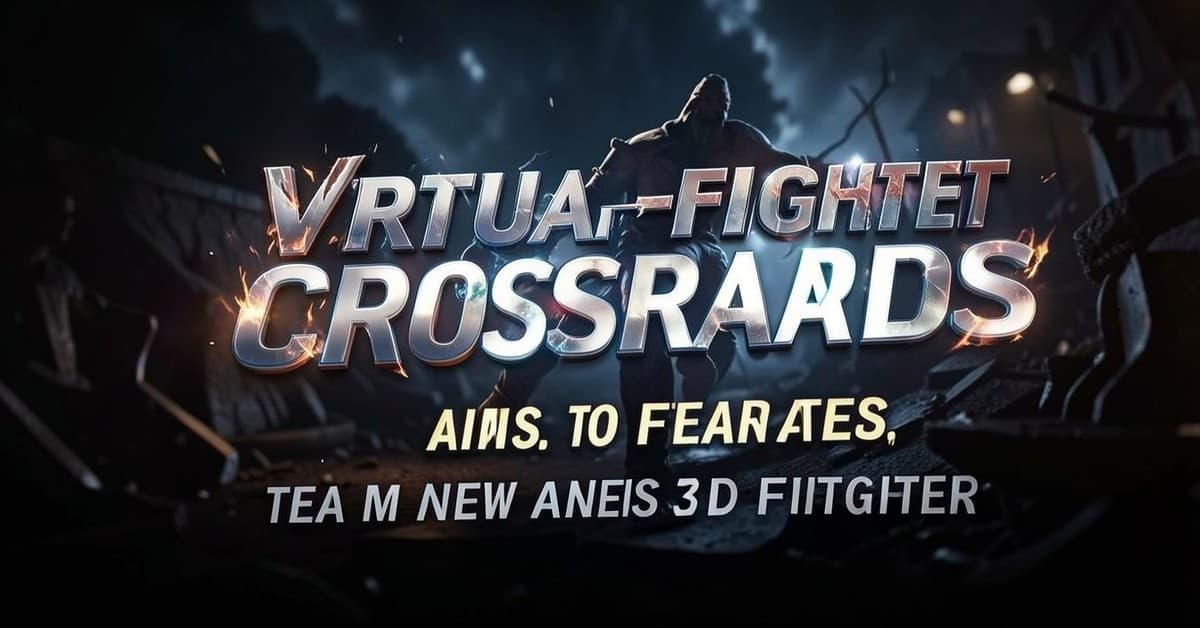
Sega is betting the future of its most historic fighting franchise on a paradox: Virtua Fighter Crossroads wants to be the most accessible entry in the series' 30-year history while preserving the "infinite depth" that made Virtua Fighter 4 and 5 tournament staples with no single dominant top-tier character. Previewed during Summer Game Fest with a 2026 release window, the game represents the first all-new mainline entry since Virtua Fighter 5 launched two decades ago. For a community that has kept the faith through Virtua Fighter 5 R.E.V.O.'s 2024 rollback netcode update and a subsequent World Tour, Crossroads is either the revival they have waited for or a fundamental misunderstanding of what made the series special.
Quick Facts — Virtua Fighter Crossroads
| Publisher | Sega |
|---|---|
| Release Date | 2026 |
| Genre | Fighting |
The stakes are higher than a simple sequel. Virtua Fighter invented the 3D fighting genre, yet it has watched contemporaries like Tekken and Street Fighter become household names while it remained a cult favorite. Producer Riichiro Yamada and IP head Toshihiro Nakaya told IGN they are not just making this new system, [we] really thought like, 'All right, what is great? What fun about Virtua Fighter?' And [we] had to really decide what to keep and what not to keep because making a whole new system is a bit much. It would make it just so convoluted for new players, too. So the goal is taking the old system and making it so that all the new players can jump in, have a good time, and understand where to get better, but make sure to keep that sort of infinite depth."
What Is Virtua Fighter Crossroads?
Virtua Fighter Crossroads is a 3D fighting game developed and published by Sega, scheduled for release in 2026. The game retains the series' signature three-button control scheme — punch, kick, and guard — while building an entirely new narrative framework around it. Set ten years after the fall of the Judgement 6 organization that drove previous entries, Crossroads moves the action to Vilasapara, a fictional Southeast Asian nation where firearms are outlawed and disputes are settled through martial arts. Organized crime thrives in this vacuum, providing the backdrop for a story mode that Sega describes as branching based on player performance.
The project draws heavily on Sega's RGG Studio, creators of the Yakuza/Like a Dragon series, for narrative structure but aims for a tone closer to Alan Moore and Dave Gibbons' Watchmen — grounded realism rather than anime spectacle. Yamada explicitly contrasted Virtua Fighter's martial arts film DNA against modern fighters inspired by manga, positioning Crossroads as a return to the genre's cinematic roots. The game will launch on platforms yet to be confirmed.
Story Mode That Teaches While It Entertains
The single-player campaign is Crossroads' most ambitious departure. Yamada told IGN the team wants to "go above the genre." The increased focus on story is part of that ambition, and the team also wants to make something that will teach new players how to play fighting games as they play the story. Players control Cielo, a Paraguayan immigrant with an American father who has fallen in with the Chinese mafia in Vilasapara. His underdog status mirrors the developer's goal: a protagonist learning the ropes alongside the player. Branching outcomes mean fight performance alters the story, though Sega remains vague on exactly how deep those divergences run.
Legacy characters appear as both mentors and antagonists. An older Pai Chan featured prominently in the reveal trailer, but Yamada emphasized fluid allegiances: "During the game, you'll meet all of the old characters, and they won't always be allies. They might be enemies. It goes back and forth. So maybe not Cielo, maybe other people. You might learn from Pai, or you might not. You might learn from other characters." This dynamic suggests a Yakuza-style substory system where relationship cultivation open ups moves, lore, or alternate paths — a first for a series historically allergic to narrative exposition.
Three Buttons, Infinite Depth — Preserved
Virtua Fighter's genius has always been its restraint. Three buttons. No meters. No comeback mechanics. Frame data so precise that a single-frame advantage dictates entire matchups. Yamada cited Virtua Fighter 4 and 5's tournament history — where no character dominated top-level play for extended periods — as proof the formula works. The challenge is onboarding. New players traditionally hit a wall: they lose without understanding why, and the training modes have never bridged that gap.
Crossroads attempts to solve this by keeping the core system intact while layering contextual teaching into the story mode. Ring outs and environmental interactions remain, but Yamada drew a sharp distinction between story and competitive balance: "[Ring outs and stage interactions are] in there. So in the story it is a little different than just the PVP mode, but in the story mode first, we don't have to worry about balance or any of that kind of stuff. We just care about what's fun." This bifurcation — spectacle for single-player, purity for versus — could satisfy both audiences if the transition between modes feels seamless.
What Doesn't Work Yet
The preview builds optimism on promises, not playable code. IGN's writer explicitly noted they have not played Crossroads, and critical systems remain undisclosed. Body-part damage mechanics — a series staple since Virtua Fighter 4's hit-zone system — were mentioned as an unknown. The branching narrative's actual scope is unclear; "coy on details" suggests either early development or marketing holding cards close. Minigames and side content were described in broad strokes without examples, raising the specter of Yakuza-style bloat without Yakuza's writing quality.
Western writing collaboration aims for Watchmen-level grounded realism, but Virtua Fighter's roster has always leaned into archetype: the karate master, the drunken boxer, the pro wrestler. Reconciling Cielo's specific immigrant narrative with a cast that includes a kangaroo-boxing martial artist (if legacy characters return unchanged) risks tonal whiplash. The 2026 target is distant enough that significant changes are likely, but distant enough that skepticism is warranted.
Virtua Fighter Crossroads arrives at a crossroads indeed. The series that taught 3D fighters how to walk now needs to teach a new generation why they should care. Yamada's team has the pedigree — Virtua Fighter 5 R.E.V.O. proved they understand rollback netcode and modern competitive expectations. Whether they understand modern single-player expectations remains the open question. If the story mode genuinely teaches frame advantage through gameplay rather than tutorial pop-ups, Crossroads could become the fighting game onboarding ramp the genre desperately needs. If it merely drapes a Yakuza-lite narrative over unchanged arcade modes, the faithful will play it for a month and return to R.E.V.O. The ambition is real. The execution is still a promise.