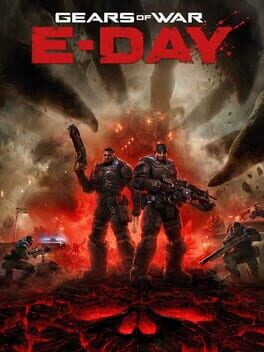
The Coalition pulled back the curtain on Gears of War: E-Day during a special episode of the Official Xbox Podcast recorded at gamescom in Cologne. Creative Director Matt Searcy and Campaign Design Director Raul Figueroa joined host Jeff Rubenstein to dissect the story trailer that debuted during Opening Night Live, offering the clearest picture yet of what the prequel campaign aims to achieve. The conversation centered on a surprising thematic core for a franchise defined by chainsaw bayonets and curb stomps: brotherhood and hope in the face of overwhelming hopelessness. For longtime fans who have spent fifteen years fighting through the ashes of Sera, the prospect of seeing the world before it burned — and the people who tried to save it — reframes the entire saga.
The developers emphasized that E-Day is not simply a greatest-hits parade of Locust variants, though the trailer certainly delivers Brumaks and armored drones in terrifying abundance. Searcy described the narrative structure as an intimate battle inside a cataclysmic event: two-thirds of Sera's population dies during Emergence Day, but by anchoring the story in the single city of Kalona and following Bravo Squad, the team can explore what it means to scrape a victory — any victory — from the first forty-eight hours. Figueroa added that the campaign will show the before, during, and aftermath, letting players connect with a living city before watching it fall. That emotional stakes work only because the setting feels familiar; Rubenstein noted that seeing recognizable urban spaces — cafes, bridges, neighborhoods — makes the destruction hit harder than the ruined landscapes of the mainline games ever could.
The Face of the Locust Threat: Vraahk and the Scorched Legion
The trailer's most arresting image arrives early: a towering Locust commander named Vraahk executing a human prisoner with casual brutality. Figueroa explained that Vraahk is a Blight Commander injured during the Lambent War who has surfaced with a singular goal — the complete elimination of humanity. Searcy elaborated that Vraahk embodies the Locust's brutality, and his elite unit, the Scorched Legion, carries that same savagery into every encounter. Their self-mutilated, spike-adorned designs signal a faction that treats violence as devotion. This is not a mindless horde; it is an army with hierarchy, history, and purpose, and the player will feel Vraahk's presence even when fighting his lieutenants block by block through Kalona.
The decision to introduce the Locust threat gradually — from the first Wretch to the first Drone, escalating to armored Brumaks — mirrors the squad's dawning comprehension of the invasion's scale. Searcy framed this progression as the game's structural spine: what begins as a monster attack on a city block expands into the realization that an entire civilization lurks beneath the surface. That pacing serves both narrative and mechanical purposes. Early encounters teach the player the new movement and weapon-modification systems against manageable threats; later set pieces demand mastery of those same tools against coordinated, intelligent enemies that can flank, climb, and adapt. The Locust are no longer turret fodder — they are active participants in the cover shooter chess match.
Kalona as Character: Exploration, Side Objectives, and Environmental Storytelling
Figueroa described Kalona as a character in its own right, built from the ground up as a functioning city with landmarks, neighborhoods, and daily rhythms that the player disrupts simply by progressing through the campaign. The team wants players to feel the loss of specific places — a bridge, a plaza, a residential district — as they transform from recognizable urban spaces into battlefields. That transformation is reinforced by gameplay: the campaign is broadly linear but opens into multi-block zones where the player chooses how to reach the next objective. Exploring off the critical path reveals other squads holding the line, families trapped in buildings, and hard cases containing gameplay rewards. Helping these optional encounters yields narrative payoff and tangible progression, tying the sandbox mechanics directly to the theme of brotherhood.
Weapon modification makes its campaign debut here, borrowing systems previously reserved for Horde mode. Players can customize loadouts to suit their playstyle, and the urban environment — cars, debris, collapsed masonry — provides natural cover variety that goes far beyond the waist-high walls of earlier entries. Searcy acknowledged the franchise's cover-shooter roots but stressed that movement has evolved: a dedicated jump button, mantle climbing, and vertical traversal give the player agency that the Locust AI now matches. Enemies will vault the same obstacles, flank from rooftops, and punish static play. The result is a combat loop where the city's density becomes a tactical asset for both sides, and the player's growing toolkit is answered by an enemy that learns to counter it.
Why E-Day’s Brotherhood Trumps Guns
The central tension of a prequel is dramatic irony — the player knows Sera loses. The Coalition leans into that knowledge rather than hiding from it. Searcy acknowledged the hopelessness outright: most of the population dies, the war lasts decades, and the world becomes the ash-choked ruin veterans know. But by zooming in on two days in one city, the game asks a different question: what does resistance look like when the outcome is already written? The answer, delivered through Bravo Squad's bonds, the mayor and colonel's political fracture, and the strangers the player chooses to save, is that brotherhood and loyalty have intrinsic value independent of victory. That thematic argument — that how you fight matters more than whether you win — gives E-Day a philosophical weight the franchise has only gestured at before.
For players, this means a campaign that respects the lore while refusing to be shackled by it. The first appearance of every enemy type becomes a discovery shared with the characters, not a checklist for the player. The city's destruction unfolds in real time around landmarks the player has learned to navigate. And the new movement and modification systems ensure that the moment-to-moment combat feels like a 2025 action game, not a 2006 one preserved in amber. The Coalition is betting that the series' most devoted fans will stay for the spectacle — Brumaks crashing through bridges, Vraahk's looming shadow — but that the quiet moments of a squad dragging a wounded civilian through a burning hallway will be what lingers. If they pull it off, Gears of War: E-Day could be the rare prequel that deepens the entire franchise retroactively.
Key Takeaways
- The campaign takes place in the city of Kalona over the first two days of the Locust invasion, focusing on Bravo Squad and the theme of brotherhood amid hopelessness.
- New antagonist Vraahk, a Blight Commander leading the Scorched Legion, embodies Locust brutality and is introduced in the story trailer during Opening Night Live at gamescom.
- Weapon modification comes to the campaign for the first time, and movement options now include a jump button, mantling, and vertical traversal matched by smarter Locust AI.
- The game features optional side objectives — helping other squads, rescuing civilians — that provide narrative rewards and gameplay progression within semi-open city blocks.