
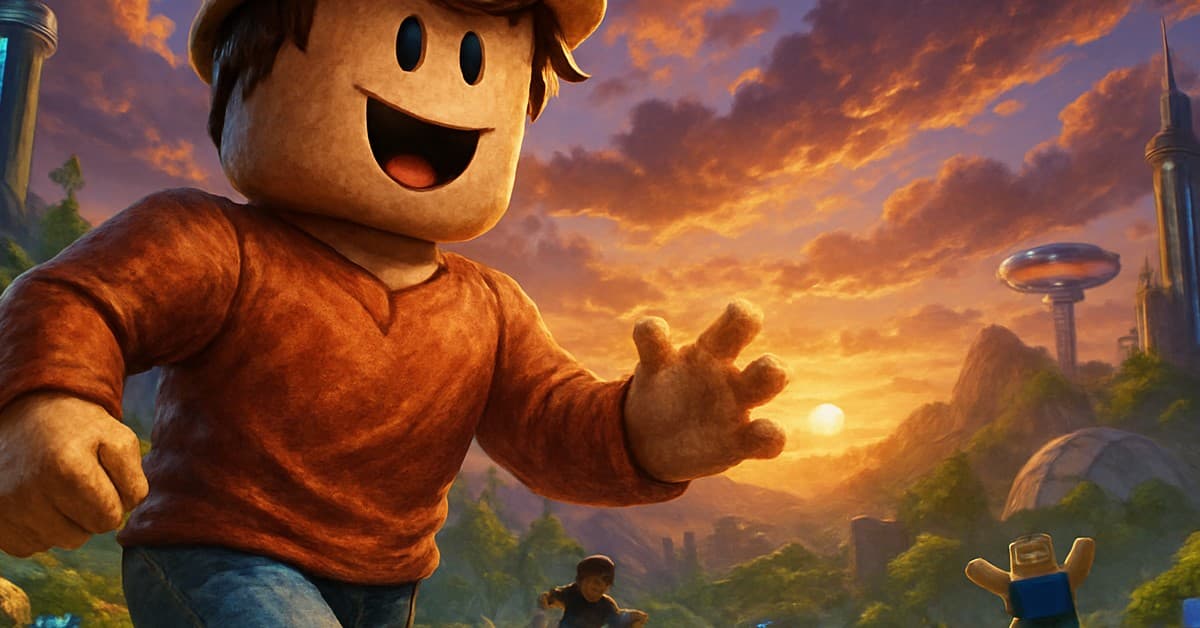
Roblox is showcasing its new AI-powered upscaling technology, aimed at enhancing the game's visual fidelity. This tech allows the game to transform its traditionally blocky characters and environments into photorealistic visuals, a significant leap for the platform.
Set to roll out either later this year or early next, this innovation aims to democratize the creation process. According to Roblox CEO David Baszucki, the technology will "ultimately remove barriers to high-fidelity creation, allowing a team of three people to build a narrative-driven, photorealistic masterpiece in a single week." This potential shift could redefine how players and developers experience and create within the Roblox universe.
What Is Roblox Reality?
The new tech, dubbed Roblox Reality, employs a hybrid architecture that divides responsibilities between the Roblox Game Engine and the Roblox Video World Model. The Game Engine manages the structured and logical aspects of the world, ensuring stable long-term memory, symbolic logic, and repeatable simulation. This means that fundamental operations, like collision detection and object behaviors, will remain intact while enhancing visual detail.
On the other hand, the Video World Model incorporates visual and generative components, adding layers of realism. For instance, players can expect to see dynamic elements like water streaming down a windshield or leaves fluttering as a car zooms past. This approach allows for breathtaking visuals while maintaining a consistent data model.
Comparisons and Limitations
While Roblox's technology aims to enhance visual fidelity, it faces criticism similar to that of pure neural world models. Anupam Singh, Senior Vice President of Engineering, noted, "The interactive video models we’re seeing today are impressive, but basically vivid dreams—spectacular to look at, but fleeting and incredibly lonely." This highlights the current limitations of existing interactive models, which lack essential game elements like interactivity and persistence.
Singh also pointed out that pure neural world models cannot deliver on the promise of a persistent multiplayer experience. They often struggle with coherence over time, long-term memory, latency, and fine-grained creator control. These gaps could hinder the potential of Roblox Reality if not adequately addressed.
Potential Impact on Players
The introduction of photorealistic visuals could change the way players perceive and interact with Roblox. While some may argue that players care more about gameplay than graphics, the success of similar transformations in games like Minecraft shows that visual fidelity can attract new audiences. As Roblox continues to evolve, the challenge will be balancing aesthetic improvements with the core gameplay experience that players love.
What We Still Don't Know
Despite the excitement surrounding this new technology, many questions remain unanswered. For instance, how will players adapt to the enhanced visuals? Will this attract a new demographic, or could it alienate long-time fans who appreciate the game's original aesthetic? Additionally, the cost implications of implementing such technology on a larger scale remain uncertain, as Baszucki mentioned the need for cheaper computing resources in the future.
Read This Next
Roblox's upcoming features promise to keep players engaged, but the integration of advanced tech like this also raises concerns about accessibility and the evolving nature of gameplay. As this technology rolls out, it will be interesting to see how it shapes the future of Roblox.