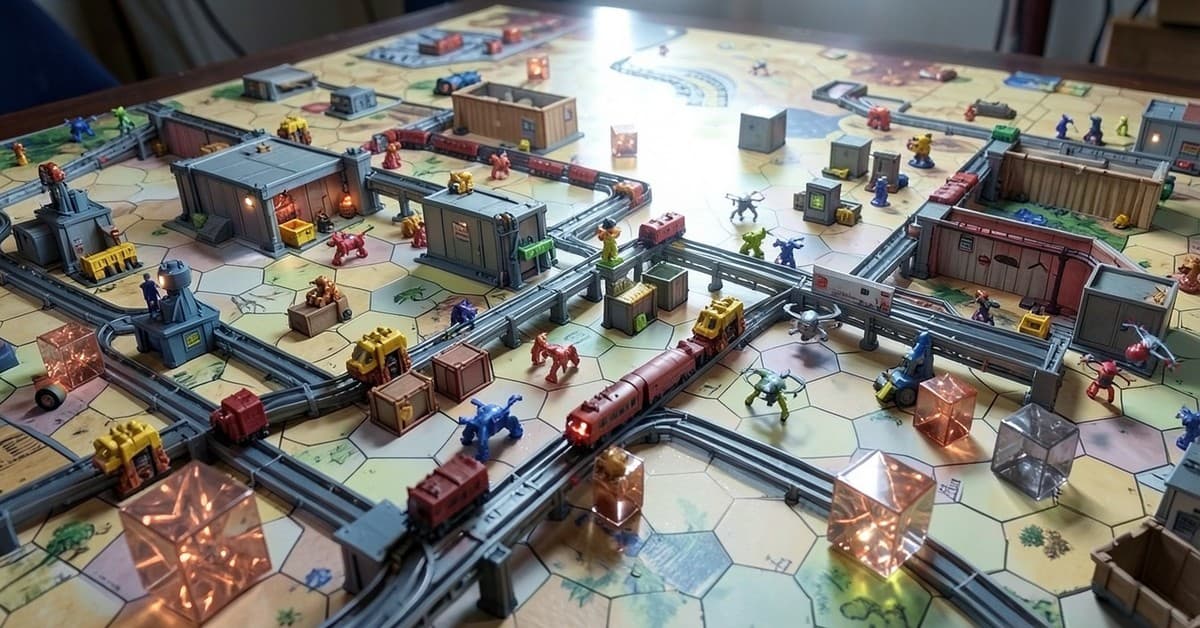
Factory-building fans have watched conveyor belts snake across PC screens for years, but Satisfactory: The Board Game finally lets you lay those belts across a kitchen table. Mood Publishing, the studio behind Hitman: The Board Game, has launched a Gamefound crowdfunding campaign for this tabletop adaptation designed by David Thor Fjalarsson. We spent time with an early prototype and a demo session led by the designer himself to see whether the sprawling automation sim can survive the shrink-ray treatment. The short answer: it largely does, provided you have enough table real estate and patience for a hefty icon dictionary.
Quick Facts — Satisfactory: The Board Game
| Developer | Mood Publishing |
|---|---|
| Platform(s) | Tabletop |
| Genre | Factory-building, Strategy, Board Game |
The game supports up to four players in its primary competitive mode, with co-op and solo variants promised for the final release. Each session unfolds on a large hex-grid map seeded with random biomes, creatures, and resource nodes — limestone, iron, and copper are the three material types you'll mine. Players take two actions per turn: build structures, move their pioneer across the map, or trigger a workshop action to advance resources along belt lines. Once everyone has acted, a production phase resolves automatically, pulling raw materials from extractors and pushing them toward refineries. The race ends when someone completes the space elevator, triggering final FICSIT point tallying. Games in our testing ran two to three and a half hours, a respectable clip for this weight class.
The Build Action and Bonus Chaining
The build action sits at the heart of the experience, and it's where the design sings loudest. Beyond staple structures like extractors and constructors, a rotating pool of tiered cards — jet packs, weapons, alternate recipe open ups — enters play as technology milestones are reached. Every major structure you place grants a bonus action tied to its function: drop a miner and you immediately place a belt for free; that belt's bonus grants a movement action; the constructor hands you an extra action on your turn. Stringing these together creates explosive turns where a single build decision cascades into three or four free operations.
"Stringing together these bonuses to create some wild turns was some of the most fun I had playing Satisfactory"
Author, Preview Session
That dopamine hit mirrors the video game's satisfaction of watching a perfectly balanced production line hum, but compressed into a single tactical decision point. The mechanic rewards forward planning — you're not just building for this turn's output, you're building to open up the bonus that fuels next turn's combo.
Player Count Changes Everything
Few games shift character as dramatically across player counts as this one does. At two players, the map feels spacious, conflict is minimal, and the game becomes a pure optimization puzzle — how efficiently can you convert raw cubes into milestone points before the elevator finishes? At three and especially four players, the same map turns into a territorial scramble. Claiming a tile locks it for your exclusive development, forcing opponents to route around you or fight for the remaining rich nodes. Blocking and expansion denial become valid strategies, though direct sabotage — destroying belts or extractors — isn't part of the ruleset.
"It honestly felt like I was playing different games based on the player counts"
Author, Preview Session
The two-player game allowed a milestone rush where four early objectives were completed back-to-back-to-back in a single turn, a sequence the author called "a straight dopamine shot to the system, and basically sold me on Satisfactory alone." That kind of explosive scoring turn simply doesn't exist at higher counts because the board state is too contested. Your preferred player count may come down to whether you want a solitaire optimization exercise or a tight area-control race.
Faithful Adaptation With Tabletop Constraints
Even this condensed package still manages to FEEL like Satisfactory. The conveyor belt network spreads visually across the hex grid, alternate recipes open up mid-game to rewire your production chains, and technology tiers gate access to advanced structures like the jet pack. Longtime players will spot nods like Bean the critter and biome-specific resource bonuses. The three-material limit (limestone, iron, copper) is a smart abstraction that keeps resource management readable without sacrificing the tiered refinement loop — raw ore becomes ingots, ingots become wires or plates, plates become modular frames, and so on up the chain.
The space elevator victory condition provides a clean narrative endpoint that mirrors the video game's phase progression. Milestones offer early-game point injections that keep scores ticking upward before the heavy machinery comes online. It's a clever pacing mechanism: you can chase quick milestone points or invest in long-term engine building, and both paths feel viable in the prototype. The competitive race format diverges from the PC game's cooperative focus, but the promised co-op and solo modes should restore that flavor for groups who prefer shared factory building.
Component Scale and Icon Density
If there is one thing that interested builders should be aware of, it is that Satisfactory is not a small game. It requires a good bit of table space to play, and it will assault you with icons. The main board, four player boards, multiple card decks, resource token piles, and victory point track combine into a footprint that dominates a standard dining table. More critically, iconography carries heavy lifting across every component — resource types, structure categories, bonus triggers, biome effects, and milestone conditions all communicate through symbols rather than text.
"Frankly, keeping track of and remembering what all the icons meant was more of a hassle than managing my stockpiles of colored cubes"
Author, Preview Session
The prototype lacked a player reference card, though Mood has confirmed one will ship with the retail version. Even with that aid, the learning curve is real: it took most of a first game for the icon language to click. This isn't a dealbreaker for experienced hobby gamers, but casual groups should budget an extra half-hour for the rules teach and expect frequent "wait, what does this symbol mean?" pauses in the early rounds.
Mood Publishing appears to have succeeded in distilling Satisfactory's sprawling systems into a surprisingly approachable board game that still feels like its digital ancestor. The limited action economy keeps turns snappy, the bonus-chaining build mechanic delivers genuine tactical highs, and the player-count elasticity means the game serves different appetites depending on your group size. Component bulk and icon memorization are real friction points, but the promised reference cards and ongoing development should smooth the roughest edges. If you've ever wanted to argue about optimal belt routing in person rather than over Discord, this one deserves a spot on your watch list.
Sources
Stringing together these bonuses to create some wild turns was some of the most fun I had playing Satisfactory.
Frequently asked questions
Who is the publisher of Satisfactory: The Board Game?
Mood Publishing is the publisher of Satisfactory: The Board Game.
Who designed Satisfactory: The Board Game?
David Thor Fjalarsson designed Satisfactory: The Board Game.
Where is the crowdfunding campaign for Satisfactory: The Board Game being hosted?
The crowdfunding campaign for Satisfactory: The Board Game is being hosted on Gamefound.
How many players does Satisfactory: The Board Game support?
Satisfactory: The Board Game supports up to four players.
Does Satisfactory: The Board Game have cooperative or solo modes?
The promised final game will include co-op and solo modes in addition to the competitive main game.