
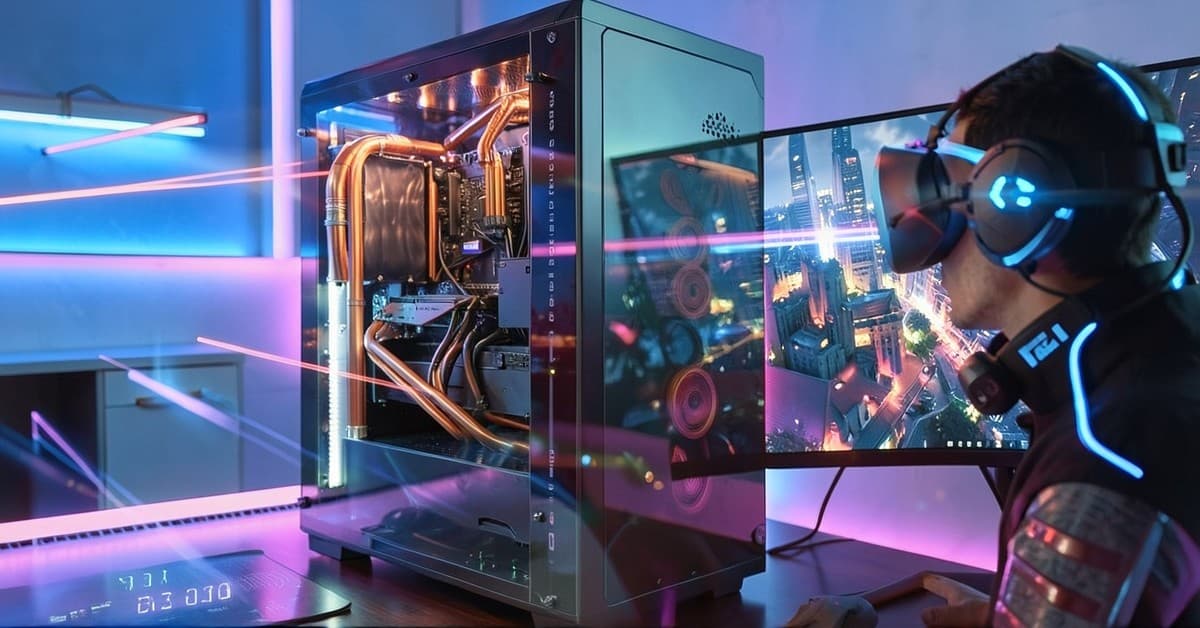
The Skytech Gaming Blaze 5 arrives as a pre-built compromise you can see coming from the spec sheet: an Nvidia GeForce RTX 5070 12GB GPU and AMD Ryzen 7 9800X3D processor stuffed into a tempered glass mid-tower that measures 18.3 x 20.6 x 9.4 inches. For $2,299, you're buying mid-tier silicon in a chassis that prioritizes RGB spectacle over serviceability, and the trade-offs start showing up the moment you try to plug in a headset. This isn't a bad computer — it runs Cyberpunk 2077 at 60 fps in 4K with ray tracing maxed and DLSS Performance enabled — but it's a computer that makes you work for every upgrade, every cable management session, and every time you want to turn off the light show.
Quick Facts — Skytech Gaming Blaze 5
| Developer | Universal Studios Hollywood Hub |
|---|---|
| Platform(s) | PC |
| Score | 7 |
| Price | $2,299 |
Rami Tabari put it bluntly: "A custom pre-built gaming PC like the Skytech Gaming Blaze 5 is going to save you a lot of work if you're not technically savvy or simply don't have the patience to put together a modern-day puzzle." That convenience is real — the system arrives with Windows installed, drivers updated, and 32GB of RGB RAM already humming alongside seven case fans and an 850W Gold PSU. But the same review notes that upgrading or replacing components means moving things out of the way because the motherboard is crowded. For a machine at this price point, that friction matters.
The $1300 PC With a Cluttered Case
The tempered glass panels on the Blaze 5 slide off with a satisfying click—pegs and a clip secure the main side, while a lift‑and‑slot design releases the front. Inside, the RTX 5070 sits snugly, but there’s very little room under it for the two PCIe 4.0 x16 slots; you’ll need components with a slim profile that can cope with tight spaces. Cable management looks tidy on the front panel, with zip ties and neat alignment, but the non‑modular PSU forces you to replace the whole supply if you want fresh cables, meaning you’ll have to reconnect everything again. The CPU fan wires block access to the RAM slots, and the SSD is tucked in between the CPU heat‑sink and the motherboard heatsink—upgrading these parts turns into a delicate operation.
Front I/O placement compounds the frustration. The power button, headphone jack, two USB 2.0 Type-A ports, and one USB 3.2 Gen 2 Type-C port all live at the bottom of the tower, just below the front glass panel. Tabari calls it "mighty annoying if the PC is placed on the floor as opposed to your desk," and he's right — reaching down to plug in a headset or hit the power button on a floor-standing rig is a daily annoyance that never stops being annoying. The rear I/O is generous: two USB 3.2 Gen 1 Type-A, one USB 3.2 Gen 2 Type-A, five USB 2.0 Type-A, one USB 3.2 Gen 2 Type-C, RJ-45 Ethernet, three audio jacks, plus HDMI and DisplayPort on the motherboard for troubleshooting. A sticker on the back panel left sticky residue on the ports after removal, a small but telling quality-control miss.
Software and RGB Experience
Skytech keeps bloatware to a minimum, but the SignalRGB app that controls lighting, fan curves, and hardware monitoring arrives with its own tax. You must create an account to open up advanced lighting features, and a $6-per-month Pro tier removes ads — yes, ads in your RGB configuration utility. Tabari didn't mince words: "There are ads in your RGB lighting configuration app. Like I said, it is an annoying app to deal with." The monitoring interface also requires manual customization rather than offering sensible defaults.
The lighting behavior itself is buggy. There's no true "off" toggle — only pause or dim — and disabled lighting occasionally flickers back on before shutting off again. On boot, the app forgets your preference and re-enables the light show. Active effects sometimes stutter, skipping frames like a dropped buffer. For a system that wraps seven fans, two RAM sticks, and the PSU shroud in RGB bars, these software flaws turn a showcase feature into a persistent irritation.
Gaming Performance: 4K Survival, 1440p Strength
The Blaze 5's RTX 5070 and Ryzen 7 9800X3D combination delivers exactly the mid-tier numbers you'd expect. In Cyberpunk 2077 at 4K with Ray Tracing Ultra and DLSS Performance, the system averages 60 fps — playable, not breathtaking. Frame generation pushes that to 97 fps at 2x and 167 fps at 4x, though the card can't saturate 240 Hz panels. Assassin's Creed Shadows runs at 56 fps native DLSS Performance, 78 fps with frame gen. Metro Exodus, a heavier workload without upscaling, drops to 40 fps at 4K max settings. Black Ops 7 hits 121 fps at 4K, plenty for competitive play. Pragmata averages 40 fps at 4K max with DLSS Performance, 124 fps with 4x frame gen, and 71 fps at 1440p without frame generation.
Tabari's assessment lands: "You can definitely get by when gaming at 4K, but the Blaze 5 will really shine with a 1440p monitor, capturing those higher frames you want to see." That's the honest read — this hardware tier belongs at 1440p high refresh, where the 9800X3D's cache advantage and the 5070's rasterization muscle can actually stretch their legs. At 4K, you're leaning hard on DLSS and frame generation to maintain 60 fps in demanding titles, and the $2,299 price tag starts feeling heavy for "gets by" performance.
Pros
- RTX 5070 and Ryzen 7 9800X3D deliver solid mid-tier gaming performance
- Easy-access tempered glass panels with tool-less removal
- Clean cable routing on visible side of build
- Strong 1440p high-refresh performance in competitive and AAA titles
- Generous rear I/O including motherboard video outputs for troubleshooting
- Wi-Fi 6 and 850W Gold PSU provide modern connectivity and headroom
Cons
- Crowded motherboard blocks RAM access and SSD replacement
- Non-modular PSU complicates future cable changes
- Front I/O and power button at bottom of tower awkward for floor placement
- SignalRGB app serves ads, requires account, and lacks true RGB off toggle
- RGB lighting flickers, stutters, and resets on boot
- $2,299 price feels high for RTX 5070-class performance
Verdict
The Skytech Gaming Blaze 5 earns its keep as a plug-and-play 1440p machine for buyers who value convenience over value — the RTX 5070 and Ryzen 7 9800X3D are a potent pairing, the case opens easily, and the rear I/O is genuinely thoughtful. But the crowded internal layout turns upgrades into a chore, the bottom-mounted front ports are a daily ergonomic failure for floor placement, and SignalRGB's ad-supported, account-gated, buggy implementation feels hostile on a $2,299 system. If you're building a desk-centerpiece rig and never plan to open it, the Blaze 5 works. If you want a platform to grow with, build your own or look at pre-builts that respect serviceability.