
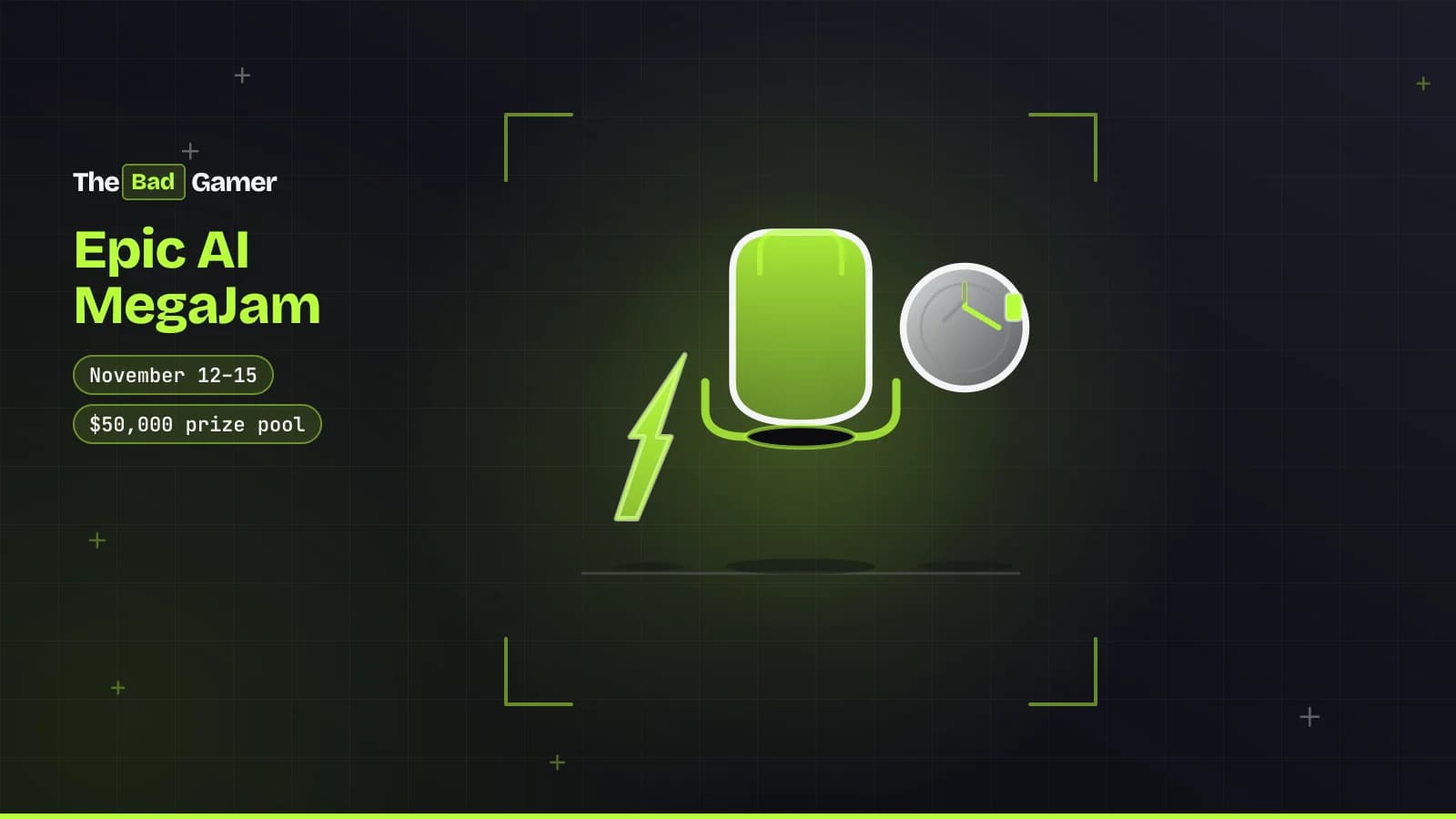
Epic Games has officially opened registration for the Epic AI MegaJam, a three-day game development competition running from November 12 to November 15 that offers a $50,000 prize pool to participants willing to embrace artificial intelligence tools in Unreal Engine and Unreal Editor for Fortnite. The contest rules permit unlimited AI usage for coding, asset generation, audio, video, and writing, while also allowing licensed third-party assets that participants did not create themselves. Teams retain full legal rights to their submissions after the event concludes, a detail Epic highlights as a benefit for developers looking to commercialize their jam prototypes.
Epic’s announcement lands at a time when the studio’s attitude toward AI has sharpened noticeably. The MegaJam’s rules, which push developers toward AI‑driven workflows, do little to assuage worries that the company is nudging teams to make AI a necessity for winning. The official Unreal Engine X social media channel spread a meme that pits a hand with six fingers holding a red pill labeled “ship awesome games in a weekend” against a five‑fingered hand clutching a blue pill that reads “wait months to prototype.” That image is a clear statement: speed achieved through AI eclipses the artistry of traditional development timelines, even if the end products fall short of perfection.
Contest Structure Favors AI-Heavy Workflows
The MegaJam’s three‑day span is where the backlash hits its peak. Epic says in its FAQ that using AI isn’t required, but cramming a launch into 72 hours leaves human‑only crews scrambling to plan, code, and refine a finished title. Critics note that even a normal 48‑to‑72‑hour jam strains indie squads; demanding a polished, ship‑ready game inside that same deadline essentially forces teams to rely on generative helpers for faster art and code.
This dynamic mirrors broader industry tensions around AI-assisted development. Developers have been told to stop handwriting code and stick to AI tools, a directive that surfaced alongside the company's pride in revealing its new store launcher was "vibe coded" — a term popularized by AI advocates to describe building software through natural language prompts rather than traditional programming — because "programming is hard." That statement, delivered without apparent irony, struck many working developers as dismissive of the engineering discipline that underpins the very engine Epic sells.
Leadership Rhetoric Escalates the Divide
CEO Tim Sweeney has taken to social media to frame AI adoption as the gateway to a "golden age of gaming." Separately, Elon Musk has expressed a vision of AI-generated games produced at scale. Sweeney's public advocacy positions Epic not merely as a toolmaker accommodating new workflows but as an ideological leader pushing the industry toward AI-first production. For a company whose flagship engine has long been marketed as the gold standard for high-fidelity, hand-crafted game development, the pivot feels jarring to longtime Unreal developers who built careers on the very craft Epic now suggests is obsolete.
Musk's goal is to refine artificial intelligence to produce AI-generated games, suggesting Epic sees itself as infrastructure for a future where game creation is democratized through prompting rather than programming. Whether that future arrives on the timeline Sweeney envisions remains uncertain.
What This Means for Developers
For independent developers and small studios, the MegaJam represents both an opportunity and a signal. The prize money is substantial for a game jam, and the permission to use licensed assets alongside AI tools lowers the barrier to producing something visually and mechanically impressive in three days. Teams that already integrate generative AI into their pipelines can treat this as a paid sprint to prototype a concept they might otherwise lack time to explore.
But the contest also reinforces a concerning precedent: major engine providers designing events that structurally disadvantage traditional workflows. If Epic normalizes the idea that a "real" prototype must be built in a weekend with AI, publishers and funders may begin expecting similar velocity from all teams — including those who cannot or will not adopt generative tools for ethical, legal, or quality reasons. The "vibe coded" launcher comment suggests Epic's leadership views programming difficulty as a problem to be routed around rather than a craft to be supported, a philosophy that could reshape Unreal Engine's roadmap in ways that alienate its core user base.
Key Takeaways
- Epic AI MegaJam runs November 12–15 with a $50,000 prize pool for games built in Unreal Engine or UEFN
- Unlimited AI tools and licensed third-party assets are permitted; teams retain full legal rights to submissions
- Three-day timeline makes it extremely difficult for all-human teams to compete effectively
- Epic leadership frames AI as essential to a "golden age of gaming" and has moved to AI-first internal development practices
The MegaJam will likely produce some technically impressive demos, and Epic will almost certainly showcase the winners as validation of its AI-first strategy. But the deeper question — whether games built in three days with generative tools can sustain player engagement beyond the novelty of their creation method — won't be answered by a contest. It will be answered by the games that ship six months from now, built by teams who either embraced or resisted this shift. Epic has made its bet. The rest of the industry is still deciding where to place theirs.
Sources
Frequently asked questions
Do participants have to use AI tools in the Epic AI MegaJam?
According to the FAQ, participants do not have to use AI tools.
Can participants use assets they did not create themselves?
Participants can use assets they didn't make as long as they have a license.
Who retains legal rights to games submitted to the Epic AI MegaJam?
Teams retain legal rights to their submissions and may use them as they wish after the contest.