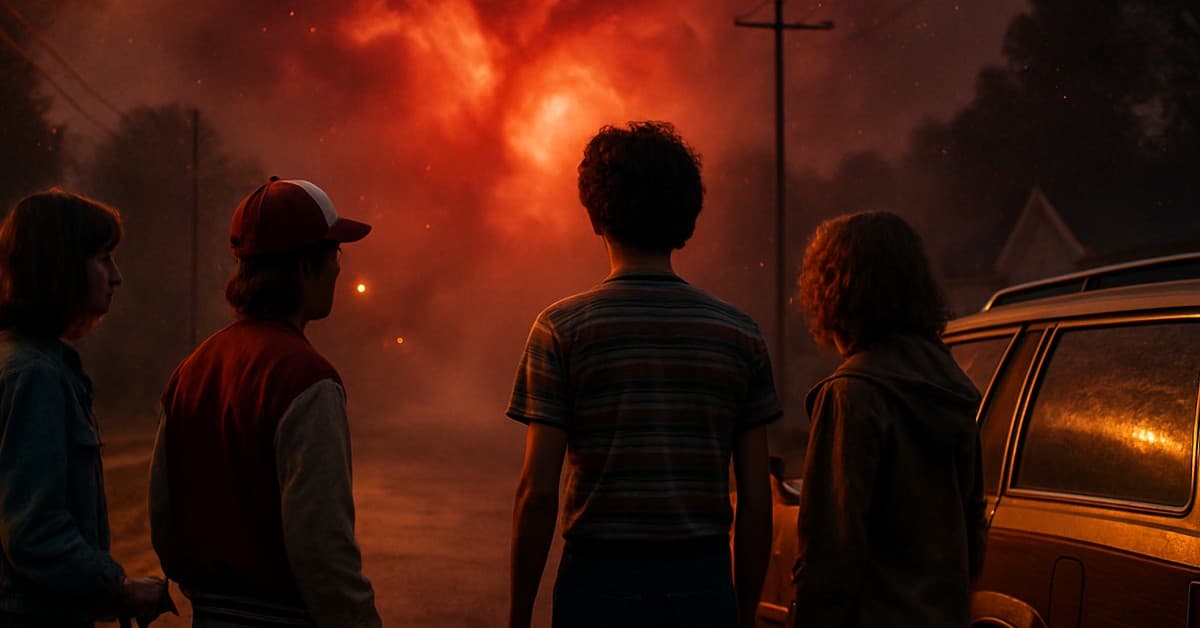
Stranger Things: Tales from ’85 opens with a familiar kind of chaos: Mike, Will, Lucas, Dustin, Eleven, and Max are back together, and this time they’re fighting demogorgon-like parasitic plant monsters in an animated series set between seasons 2 and 3. Netflix is streaming the 10-episode show now, and that timing matters because this is the first time in years that Stranger Things has felt like it remembers what made the early seasons work. If you bounced off the later live-action seasons, this version has a real shot at pulling you back in.
That’s the bigger story here. Eric Robles developed and showran the series, while the Duffer Brothers executive produced it, and the result is much better than the premise sounds on paper. The show recaptures a lot of the early Stranger Things charm, and for players who have spent years watching the franchise get bigger, messier, and less focused, that’s the main reason to care. It also makes a strong case that a tighter, kid-first Stranger Things still has plenty of life left in it.
What Is Stranger Things: Tales from ’85?
Stranger Things: Tales from ’85 is an animated Stranger Things series developed by animation veteran Eric Robles, who also serves as showrunner. Netflix streams the show now, and the series sits between seasons 2 and 3 of the original Stranger Things run. It follows Mike, Will, Lucas, Dustin, Eleven, and Max across 10 half-hour episodes, which already tells you the pitch: smaller, faster, and less crowded than the later live-action seasons.
That shift is the point. Joyce is entirely absent, Hopper only shows up a few times, and Steve and Nancy each get just one episode as prominent guest stars, while Jonathan Byers gets only a brief cameo. The show also introduces Nikki, a lonely outcast girl whose mom is the substitute science teacher, but the focus stays on the kids and their paranormal-investigation setup as the “Hawkins Investigators Club,” or “Hi-C.” For fans who wanted Stranger Things to stop stuffing the frame with side plots, this is a smart correction.
Gameplay and Mechanics
There’s no controller in your hands here, but the show still works like a well-built adventure game: the kids have a clear goal, a repeatable structure, and a reason to go looking for trouble instead of waiting for it to find them. Dustin’s “Hawkins Investigators Club,” which everyone derisively calls “Hi-C,” gives the party a simple hook that keeps the episodes moving. That matters because it stops the story from feeling like a string of random monster attacks and gives the kids an actual team identity.
The half-hour episodes help too. Shorter runtimes keep the energy up, and the narrower focus prevents the series from getting bloated with characters, which the review points to as a major problem in Stranger Things’ later seasons. The kids still argue, tease each other, eat snack food, and make pop culture references, so the show keeps the same group dynamic that carried the early seasons, just without the dead weight that dragged the franchise down later on.
Robles also keeps the tone close to the original without sanding off the edges completely. The show is more family-friendly, so you won’t hear Lucas barking “Eat shit!” the way he did in the original series, but the characters don’t turn into bland cartoon stand-ins either. That balance is the trick here, and it’s why the series still feels recognizably like Stranger Things even after the switch to animation.
- Set between seasons 2 and 3 of the original series
- 10 episodes
- Half-hour episodes
- Follows Mike, Will, Lucas, Dustin, Eleven, and Max
- Features demogorgon-like parasitic plant monsters
- Introduces the “Hawkins Investigators Club,” or “Hi-C”
Visuals, Audio, and Performance
The voice work does a lot of heavy lifting. The review says nearly all of the cast pulls off their characters convincingly, and that’s crucial because animation lives or dies on whether the voices match the faces in front of you. Hopper doesn’t quite sound like David Harbour, and Eleven’s dialogue feels stilted, but the kids mostly land, and that’s enough to keep the illusion intact. When the show works, you stop thinking about the recast and start hearing the old group dynamic again.
Visually, though, the series is shakier. The darkly rendered CGI animation fits Hawkins and makes the monsters pop, especially with the glowing aesthetic, but the human characters look doll-like, with still faces that don’t carry much emotion. That creates a strange disconnect: you can tell who everyone is, but the designs flatten their expressions and make the cast feel oddly samey. The review even says the show might have worked better as a 2D series with a strong retro style, which feels like a fair criticism rather than nostalgia talking.
There’s a comparison here to Marvel’s What If?, and not in a flattering way. The show’s character designs reportedly have even less life than that series, which is a problem because Stranger Things lives or dies on personality, not just plot mechanics. Fortunately, the writing and acting do enough to keep the characters feeling right, even when the visuals don’t fully cooperate.
What Doesn’t Work
The biggest issues are specific, and they’re hard to ignore. Hopper doesn’t sound right, Eleven’s dialogue feels stiff, Will gets a character-growth beat that he already experiences again in later seasons, and the new characters feel shoehorned in to support the plot. That last problem matters most, because Nikki’s eventual role becomes obvious before the show spells it out, which drains some of the tension from her introduction.
The review also flags the way the series handles its new additions online, where some fans have complained about the recasting and the fact that the showrunner didn’t ask the original cast to return. The critic thinks that was the right call, especially since the original actors are now in their 20s and wouldn’t convincingly play 13-year-olds. Even so, the recast still creates a barrier for some viewers, and the show’s uneven visual design gives those complaints extra room to breathe.
None of that breaks the series, but it does keep it from being a clean win. The writing on the new material is called redundant rather than bad, and that’s a useful distinction: Tales from ’85 doesn’t stumble because it forgets what Stranger Things is, but because it occasionally repeats beats the franchise already played better elsewhere. That’s a real flaw in a show built on nostalgia, because nostalgia only works when it feels earned.
Pros
- Recaptures a lot of the early Stranger Things charm
- Very good casting and voice acting
- Short, energetic, kid-focused stories
- The “Hawkins Investigators Club,” or “Hi-C,” gives the series a clear engine
Cons
- Hopper doesn’t sound right
- Eleven’s dialogue is stilted
- Will’s growth feels redundant
- The new characters feel shoehorned in and their revelations are obvious
- The human character designs look doll-like
Stranger Things: Tales from ’85 ends up as the best Stranger Things season since 2019, and that’s not faint praise. It works because it narrows the focus, keeps the kids front and center, and remembers that the franchise’s best version is a group of smart, funny kids stumbling through a nightmare with real chemistry. The voice casting mostly holds, the episodes stay brisk, and the show finally gives Stranger Things a smaller scale that suits it better than the sprawling later seasons ever did. Skip it if the recast alone is a deal-breaker, but if you’ve been waiting for Stranger Things to feel alive again, this is the one to watch.
What happens next is still unclear, since future seasons have yet to be announced, but the final episode seems to suggest the story isn’t done. That makes the first season’s success even more important, because Tales from ’85 now has to prove it can keep this balance without leaning too hard on nostalgia or familiar faces. For now, though, Netflix has a Stranger Things spin-off that actually earns its existence, and that’s more than most fans probably expected.