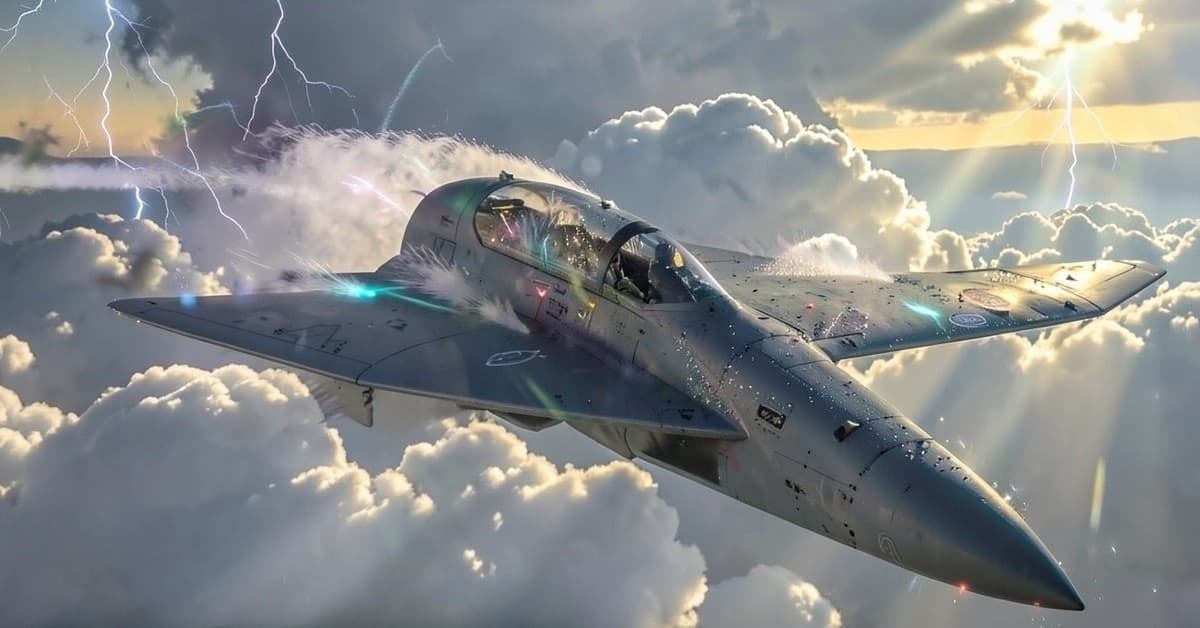
Two missiles arc toward a hapless enemy F2-A while droplets pepper the windshield, visibility reduced to garbage by a glowering grey cloud. The Endurance comes under fire from a Tonitrus Spear packing a high-output laser and broad-range jammer — a bad combo by any pilot's reckoning. Cockpit icing warnings flash red as the music swells with desperate urgency, strings bowing like they know the situation has gone sideways. Forty-five seconds. Thirty. Ten. Nine. Eight. The airship finally appears in the crosshairs, but the last LAAM launches too late. Three. Two. One. Then the cutscene triggers: Shot landed. Joker 1, target destroyed. The controller flies from your hands. This is Ace Combat 8: Wings of Theve at its most distilled — a series that has always wanted you to feel like Maverick finally earning its Top Gun wings.
Quick Facts — Ace Combat 8
| Developer | Bandai Namco Aces |
|---|---|
| Publisher | Bandai Namco Entertainment |
| Platform(s) | Microsoft Windows, Xbox Series X and Series S |
| Release Date | 2026-10-02 |
| Genre | combat flight simulator game |
| Score | 4.0 |
Developed by Bandai Namco Aces and published by Bandai Namco Entertainment, the game arrives October 2, 2026 on Microsoft Windows and Xbox Series X|S. For players who have spent decades threading needles through canyon runs and dodging missile swarms across Strangereal, this entry represents the series' most ambitious swing yet at cinematic spectacle. The campaign centers on a propaganda construct — the titular Wings, a media invention to bolster morale in a war that has left people desperate for symbols of hope. When your predecessor falls during the prologue with a kill count that hasn't reached single figures, you inherit the mantle. It's a clever alignment: the series has always sold the fantasy of the seasoned ace, and now it hands you a character who is explicitly faking it until the missions make it real.
What Is Ace Combat 8: Wings of Theve?
At its core, this remains a combat flight simulator game built around real-world aircraft rendered with the reverence Gran Turismo reserves for showroom cars. The Strangereal setting returns with its familiar absurdities — space elevators, land battleships, colossal transports with thousand-metre wingspans — alongside enemy pilots who broadcast dad-rock over open channels to announce their arrival and wingmen who pluck mournful guitar solos on carrier decks at sundown. Yet the scenarios carry an uncomfortable plausibility, particularly in scenes of devastation that evoke imagery from Gaza and Ukraine in recent years. The game never lets you forget you're a cog in both the war machine and the propaganda machine, even as it demands you become the legend inspiring the folks back home.
The structure spans 30 missions that rarely let you breathe. Even landing and refuelling sequences — traditionally the series' moments of respite — get upended by fresh threats converging against the clock. This relentless pacing is the defining characteristic: the opening sortie's command to "Move. Don't think. Quickly now" functions as something close to a mission statement. Few series communicate urgency this well, though the equilibrium between exhilarating and exhausting wobbles during the most arduous sorties. For players seeking a pure arcade flight experience with modern production values, the proposition is clear. For those who find virtual conflict a poor escape right now, the game's unflinching intensity warrants consideration before purchase.
Gameplay and Mechanics
Clouds are not merely visual spectacle — they are tactical terrain. Venturing into cloud cover reduces visibility and missile lock-on range, making you "a little less cumulo-nimble" in the game's own phrasing. This creates genuine risk-reward decisions: hide from radar and visual acquisition, but sacrifice situational awareness and offensive capability. The icing mechanic adds another layer, rattling the cockpit with warnings as you climb through moisture-heavy formations. These systems elevate weather from backdrop to active participant in every dogfight, forcing pilots to read the sky as carefully as the radar.
Loadout customization rewards experimentation over raw stat-chasing. New planes with better stats tempt immediately, but parts that extend missile range, reduce stall likelihood, or boost durability often prove more decisive. Teammate commands make a surprising difference — ordering wingmen to break formation thins enemy numbers while you focus priority targets, and special weapon deployments can enhance your capabilities or disrupt opponents. The radio chatter becomes a parsing challenge: wingman quips vie with admonishments from other pilots, instructions from multiple sources, and noisy missile alerts. Learning to filter vital information from incidental noise becomes a skill unto itself, and the game demands total attention at all times. A moment's distraction during a valley run escorting a rustbucket transport — "MANPADS!" shouted repeatedly — can cascade into a frantic race against converging fighters and a ticking clock.
Visuals, Audio, and Performance
The skyboxes rank among 2026's most jaw-slackening visuals, clouds rendered with volumetric density that catches light and shadow in ways that genuinely affect gameplay readability. Explosions bloom with physical weight, and the head-on replay camera borrows liberally from Top Gun: Maverick's visual language — though without the practical photography that made Kosinski's film feel visceral. The soundtrack swells with orchestral urgency precisely when the timer hits single digits, strings driving the pulse faster than any HUD warning could. On Xbox Series X|S and Windows, the performance holds steady through the most chaotic furballs, though the review was conducted with a DualSense Edge controller whose adaptive triggers and haptic feedback add tactile dimension to stall warnings and missile impacts.
The audio design deserves particular credit for making information density playable. Radio chatter layers multiple conversations — Tasha's anxious updates, Coster's terse "Don't panic. Stick to your training," the precursor spirit's portentous whispers — without becoming indecipherable. Enemy pilots taunt over open channels with theatrical flair, and the wingman's guitar interludes during quiet moments provide genuine atmospheric contrast. The sound of a missile whistling past the canopy in cloud cover carries directional cues that survive the mix. This is audio design that respects the player's need to parse chaos, not just drown in it.
What Doesn't Work
The first-person interstitials with a silent protagonist never justify their existence. Limited inputs — look, zoom, occasional "press X to shake hands" prompts — create awkwardness without intimacy. The precursor spirit, lingering like an Obi-Wan-esque presence, delivers lines like "the ocean sits there like an open coffin" in a whispery growl that sounds uncomfortably like Christian Bale's Batman voice. This unintentional comedy undermines the game's serious-minded ruminations on war, propaganda, and the gen-AI era's spread of falsehoods. The narrative wants to have it both ways: handwringing about human cost while glorifying the combat that produces it, reserving greater ire for social media than for the war machine itself.
The relentless pace that defines the highs also creates the lows. Over 30 missions, the Shyamalan-level appetite for eleventh-hour twists means surprises become the norm — when a mission ends as anticipated, it feels like a letdown. "One Last Threat" appears once too often, and some sorties push well past the half-hour mark with checkpoints that ameliorate frustration but reduce replayability. The difficulty spike early on may gate less experienced players before the systems click. For a series that has historically dodged the military-entertainment complex conversations that dog Call of Duty and Battlefield, the thematic muddle feels like a missed opportunity to say something coherent through its Strangereal lens.
Pros
- Cloud mechanics integrate weather into tactical decision-making
- Loadout and teammate systems reward experimentation and planning
- Spectacle-driven missions deliver consistent cinematic highs
- Audio design makes dense radio chatter parseable
- Strangereal setting retains its unique charm and absurdity
Cons
- First-person interstitials with silent protagonist feel awkward and pointless
- Precursor spirit's Batman-like voice adds unintentional comedy
- Narrative tries to critique war while glorifying combat
- Relentless pace shifts from exhilarating to exhausting over 30 missions
- Excessive late-game twists reduce replay value of longer sorties
Ace Combat 8: Wings of Theve earns its 4.0 score by delivering the most spectacular, mechanically rich campaign the series has ever produced — then nearly exhausting its welcome through sheer insistence on topping itself. The cloud mechanics alone justify the entry fee for flight sim enthusiasts, and the loadout depth rewards the tinkerer's instinct. But the narrative indulgences and relentless intensity mean this isn't a game to marathon; it's one to savor in bursts, letting the euphoria of a last-second save fade before the next "Move. Don't think. Quickly now." For the faithful, it's the series operating at peak confidence. For newcomers, it's the most accessible on-ramp yet — provided you can stomach the propaganda.
Sources
The Endurance is being targeted. Uh-oh. Tonitrus Spear arriving in two minutes! They've got a high-output laser and a broad-range jammer. Sounds like a bad combo.