Discovery Under A Maastricht Church
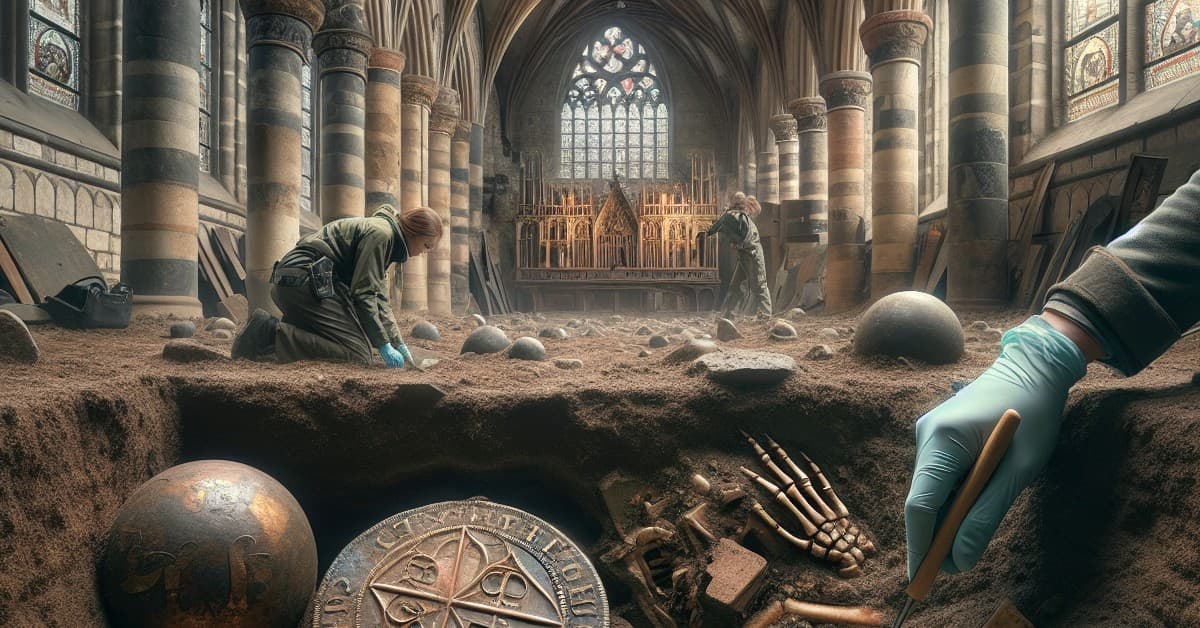
A musket ball and a 1660 coin surfaced alongside human bones beneath the floor of St Peter and Paul Church in Maastricht — evidence that could point to the resting place of the real-life inspiration for D’Artagnan.
Deacon Jos Valke helped uncover the remains after broken tiles exposed a cavity below the nave. He says he is "99% certain" the skeleton belongs to Charles de Batz de Castelmore, better known as Count d’Artagnan, a close aide to Louis XIV and the 17th-century soldier who inspired Alexandre Dumas’ swashbuckling hero.
Archaeologist Wim Dijkman, who has spent 28 years researching where D’Artagnan might be buried, led the investigation on site. The bones lay beneath the spot where an altar once stood two centuries ago — precisely the kind of sacred ground that would match a high-status burial from the period.
BBC reporting helped bring the story to light, and the details Valke shared add weight to the claim. "He was buried on sacred ground below where the altar was; we found the bullet that put an end to his life and we found a coin from 1660 in his grave, and it was from the bishop who attended Mass for the Roi Soleil," Valke told the outlet.
D’Artagnan died in 1673 during the Siege of Maastricht, part of the Franco-Dutch War, and was later mythologized by Dumas as the spirited companion to Athos, Porthos, and Aramis. Rumors long placed his grave at this very church, but no one had probed far enough until now.
Who Was The Real D’Artagnan?
Under the uniform and legend sat a real Gascon noble: Charles de Batz de Castelmore, a career officer who rose to command the Musketeers of the Guard under Louis XIV. His battlefield death outside Maastricht marked the end of a soldier’s life and the beginning of a literary one once Dumas adapted 17th-century memoirs and lore into The Three Musketeers.
Dumas didn’t imagine the rest of the squad out of thin air either. Athos drew from Armand de Sillègue d'Athos d'Auteville, Porthos from Isaac de Portau, and Aramis from Henri de Aramitz. The novel’s blend of documented figures and high adventure helped the story travel well beyond France and across centuries.
That crossover appeal explains why this discovery resonates outside academic circles. If the bones in Maastricht do belong to D’Artagnan, the find ties a global pop-culture icon to a specific, physical place — and to a single shot fired in 1673.
Tests Underway, Answers Pending
Dijkman has urged patience while the science catches up with the story. DNA analysis and other tests are ongoing in Germany and the Netherlands. Results should clarify whether the skeletal remains, the musket ball, and the coin align with a man of D’Artagnan’s age, origin, and era.
Provenance will hinge on several threads: genetic comparisons where possible, isotopic signatures that reflect diet and geography, and the archaeological context beneath the former altar. Valke’s confidence is notable, but Dijkman’s caution underscores how rare it is to close a 350-year-old case without rigorous lab work.
Either way, the church floor has already yielded something new — tangible artifacts from the Siege of Maastricht and a burial that fits the traditions of the time. That’s a significant step beyond folklore.
Musketeer Legacy On Screens And In Games
D’Artagnan’s adventures have stayed in rotation for more than a century of film and television. The 1970s delivered two star-studded features anchored by Michael York as the bold young swordsman. The 1990s saw Disney’s The Three Musketeers with Chris O’Donnell in the lead and later The Man in the Iron Mask, where Gabriel Byrne played an older D’Artagnan opposite Leonardo DiCaprio’s dual roles.
Modern takes kept coming, from 2001’s The Musketeer and Paul W.S. Anderson’s 2011 version to the BBC series The Musketeers and the recent French two-parter, The Three Musketeers: D’Artagnan and Milady. Even games have taken a swing at the legend — Nintendo published a Three Musketeers title back in 2006, a reminder that rapier-rattling stories still find new platforms.
If scientists confirm the identity, expect the spotlight to swing back to Maastricht. A verified grave could spark museum exhibits, pilgrimages for literature fans, and, inevitably, fresh adaptations eager to anchor their drama in newly proven history. After centuries of fiction, the Musketeer who wouldn’t die on the page may finally have a permanent address.