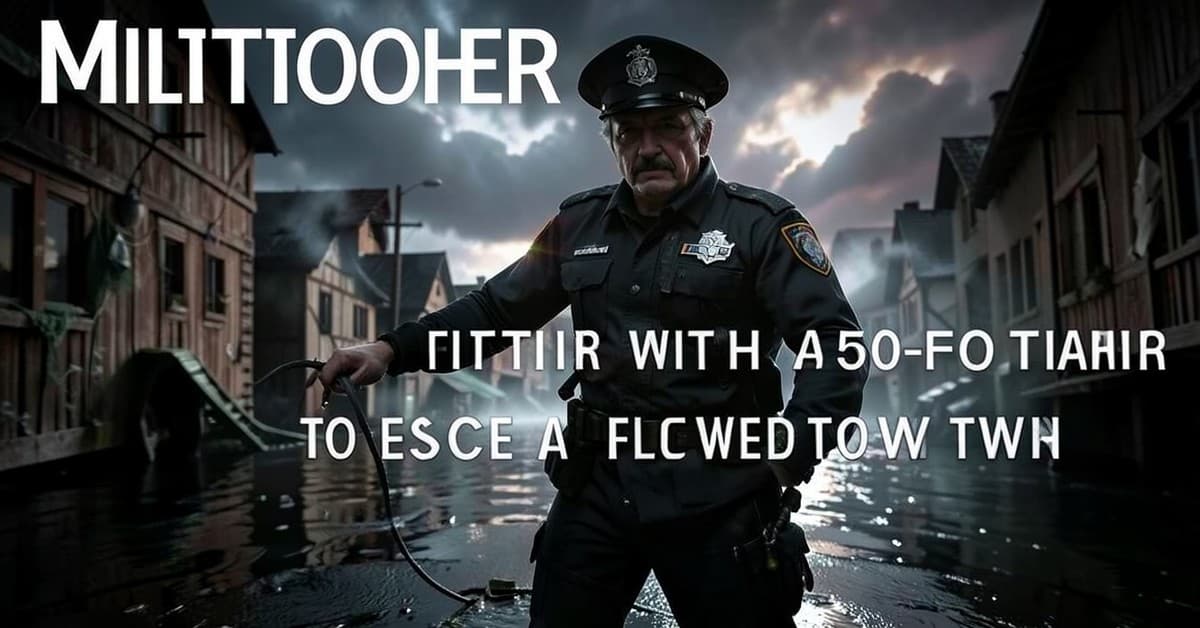
Militsioner opens with a premise that sounds like a fever dream: you are tiny, the law is a 50-foot giant, and the only way out of town involves bribing him with a vending-machine donut or possibly flirting your way into his good graces. The preview builds around a hands-on demo session that makes it clear this is not a standard stealth or escape game — it is a systems-driven sandbox where every NPC, object, and environmental shift reacts to player choices. For anyone tired of scripted sequences that play out the same way every time, Militsioner offers a refreshing alternative: a town that feels alive precisely because it refuses to hold your hand.
The core tension comes from the Colossal Policeman — his government name, per the Steam page — who looms over the map like a movable landmark. He watches, he judges, and he occasionally picks you up to interrogate you at eye level. The previewer describes the unnerving sensation of moving through streets while a being larger than a house tracks your every step. That persistent surveillance creates a unique psychological pressure; you are not hiding in shadows so much as performing for an audience of one. The fact that he is hungry, sad, and specifically craving a donut adds a layer of dark comedy that keeps the premise from feeling purely oppressive.
Here's a thinking process:
Freedom defines the moment-to-moment experience. The previewer wandered into a pawn shop, sold found items including a guitar and stolen cash, scraped together enough currency for a vending-machine donut, and presented it to the policeman — who accepted it with confused gratitude. That single interaction shifted their relationship enough to open up new dialogue options, including an attempt at flirting. The previewer admits the flirtation was a desperate tactical choice: maybe he won't arrest me if he likes me. This social-manipulation layer sits alongside more traditional adventure-game logic — bricks break doors, fake train tickets expose traps, and a mysterious hand emerging from sewer grates hints at an entirely separate escape route.
Time advancement works through benches scattered around town. Sitting on one fast-forwards the clock, which the previewer used to attempt a nighttime infiltration of the train station. The strategy backfired spectacularly: the town flooded to chest height, the water kept rising, and there was nowhere left to run. Death triggered a post-run screen revealing mood-improvement points earned by cheering up the policeman — points that can be spent on upgrades for the next attempt. That moment crystallized the roguelike structure: each run is a learning loop, not a failure state. The previewer calls the realization clever, and it reframes every earlier diversion — the guitar, the apple, the argument with the ticket seller — as data gathering for a more efficient future escape.
Here's a thinking process:
The preview does not specify frame-rate targets, resolution modes, or hardware requirements, but the descriptive language paints a clear picture of scale and atmosphere. The 50-foot policeman dominates the skyline, his animations conveying weight and melancholy rather than cartoonish exaggeration. Flood water rising to chest level transforms familiar streets into a desperate vertical scramble. Environmental storytelling — bricks left conveniently near a locked door, the hand in the sewer grate, the pawn shop's eclectic inventory — suggests a world designed for observational players who enjoy piecing together narrative fragments. The previewer notes the town did not seem large, yet remained a stranger by the end of the demo, implying density over breadth.
Sound design receives no explicit breakdown, but the previewer's focus on dialogue — the policeman's hunger, the ticket seller's accusations, the lawyer-arm's deception — indicates writing and voice direction carry significant narrative weight. The shift from daytime tension to nighttime flood likely brings audio cues that signal danger before it becomes visible. Without concrete technical specs, the impression remains one of deliberate art direction over raw graphical showcase: the giant cop reads instantly, the flood conveys urgency, and the sewer hand teases mystery without a single tutorial prompt.
Here's a thinking process:
The demo's time limit forced the previewer to rush the final escape attempt, leaving multiple threads unresolved — the sewer hand, the train-station interrogation, the policeman's request for music. That constraint is a demo artifact, not a design flaw, but it highlights how much Militsioner expects players to discover organically. The previewer failed to convince the ticket seller of innocence because a specific knowledge check was missing; the guitar served no mechanical purpose despite the policeman mentioning a desire for music. These dead ends could frustrate players who expect every introduced element to pay off immediately. The roguelike structure mitigates this — knowledge persists across runs — but the first hour may feel opaque to anyone unwilling to experiment and die repeatedly.
Another friction point: the previewer's "friend" — a giant arm hanging from a window — lured them into a trap house with a fake train ticket. The escape required smashing a door with bricks that happened to be lying around, a solution that feels slightly convenient. Environmental puzzles that rely on conspicuously placed debris can strain immersion if overused. The flood event, while dramatic, ended the run abruptly with no clear warning system beyond rising water; a visual or audio tell before the point of no return would help players recognize the timer without breaking the diegetic presentation.
Here's a thinking process:
Most escape games funnel players toward a single solution; Militsioner hands you a town, a giant cop, and a toolbox of verbs — talk, trade, flirt, break, run, wait — then steps back. The previewer walked away with more questions than answers: why is the policeman colossal? What causes the flood? Who is the sewer hand? That curiosity is the strongest endorsement a preview can generate. The roguelike loop ensures each question becomes a goal for the next run rather than a plot hole. For players who value systemic depth over scripted spectacle, Militsioner looks like a rare title that trusts its systems to generate stories worth telling.
"If anything, I felt like I had more questions about Militsioner after playing it than I did going in. But maybe one more run would answer some of them. At the very least, I knew where to get a donut."
The previewer
That blend of mystery, humor, and mechanical transparency suggests a game that respects player intelligence. No release date has been announced, but the demo builds a compelling case for keeping Militsioner on your radar.
Sources
I've never done anything wrong in my life. It's really important you believe me.
Frequently asked questions
What is Militsioner?
Militsioner is a game where you try to escape a flooded town while being watched by a 50-foot policeman called the Colossal Policeman.
What kind of game is Militsioner?
It is a roguelike with a lot of freedom to go wherever you like and do whatever you want, including talking to the giant policeman or breaking into buildings.
Who is the Colossal Policeman?
The Colossal Policeman is a 50-foot-tall policeman who monitors the town, is hungry and sad, wants a donut, and can threaten to get involved if you commit crimes in front of him.
What happens when you give the Colossal Policeman a donut?
He becomes a little confused but grateful, and your relationship with him changes.
What happens when the town floods in Militsioner?
The water rises up to your chest and keeps rising until there is nowhere left to go, resulting in death and a menu to spend points acquired by improving the policeman's mood.