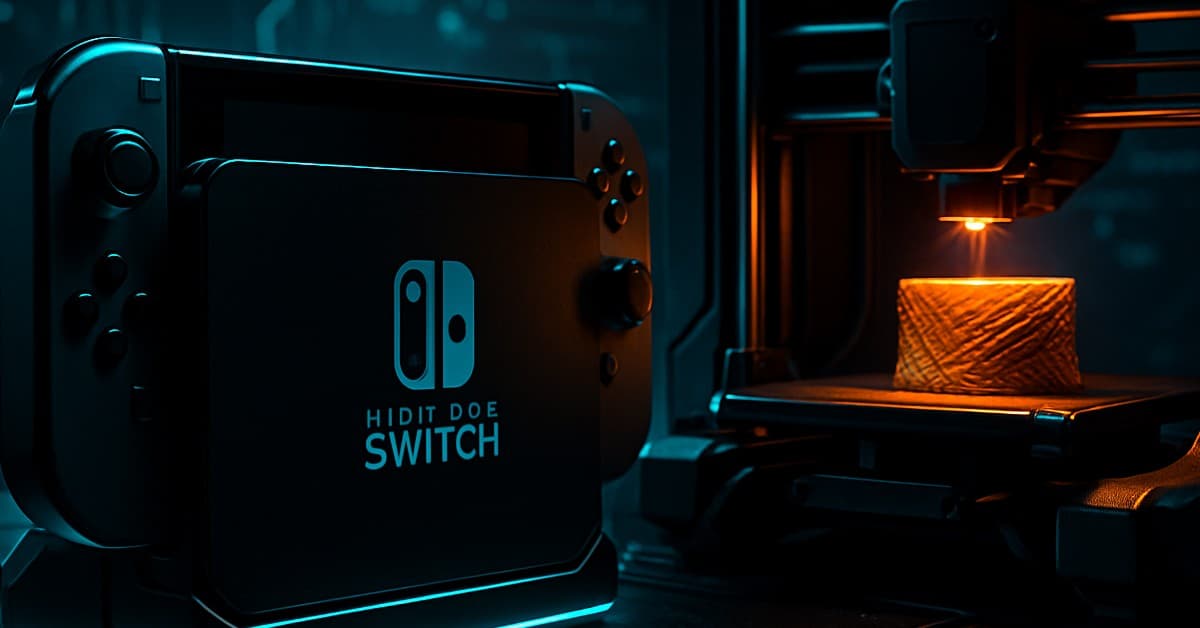
The world of 3D printing has seen an intriguing intersection with gaming technology, courtesy of YouTuber Cocoanix, who has successfully leveraged a Nintendo Switch to boost 3D printing speeds by an astonishing 1000%. By installing Linux on the Switch and utilizing the open-source Klipper firmware, Cocoanix achieved what many would consider a breakthrough in DIY 3D printing optimization.
This remarkable feat was first highlighted by Hackaday, revealing that the key to this enhancement wasn't the Switch itself, but rather the capability to offload the printer's computational workload onto a separate, more powerful device. As Cocoanix pragmatically points out:
"for most people, a Raspberry Pi is a better choice"
Cocoanix
The Klipper Advantage
Klipper, the open-source firmware at the heart of this achievement, is designed to alleviate the computational burdens typically shouldered by a 3D printer's microcontroller. Unlike standard firmware such as Marlin, which Cocoanix likened to "asking a calculator to run a spreadsheet," Klipper seamlessly offloads these tasks to an external device. In this setup, the Nintendo Switch handles the complex math and G-code processing in real-time, not only significantly speeding up the printing process but also enhancing the quality of the prints by reducing "ringing and ghosting."
An additional benefit of Klipper is its user-friendly approach to code adjustment and file editing, allowing for on-the-fly changes without the need for recompiling firmware or restarting the printer. This flexibility, combined with the enhanced performance, makes Klipper an attractive upgrade for owners of older 3D printers, as Cocoanix enthuses:
"Klipper is one of the best things you can do for an old printer" due to its being "free, powerful, and apparently runnable on a gaming handheld."
Cocoanix
Putting the Setup to the Test
Cocoanix's experimental process involved connecting the Linux-powered Switch to the 3D printer via its unique serial ID. Once connected, the focus shifted to pushing the printer's limits, achieving impressive speeds of 400 mm/s with an acceleration of 17,000 mm/s². While the printer's stock cooling system and hotend/extruder setup acted as bottlenecks, the results were nonetheless hailed as very impressive for the hardware in question.
| Metric | Value |
|---|---|
| Printing Speed | 400 mm/s |
| Acceleration | 17,000 mm/s² |
The test print, while limited by the printer's stock components, demonstrated the full potential of the Klipper firmware when paired with capable external processing. This project serves as a compelling example of the innovation possible at the intersection of gaming and DIY tech, even if, as jokingly noted, upgrading to a hypothetical "Nintendo Switch 2" wouldn't directly translate to shinier 3D printed models.
Implications and Practicality
While the Nintendo Switch proves to be an unconventional yet effective tool in this context, the broader implication of Cocoanix's project lies in the accessibility and effectiveness of Klipper firmware for the average 3D printing enthusiast. For most, as Cocoanix suggests, a Raspberry Pi offers a more accessible and cost-effective pathway to achieving similar, if not comparable, enhancements in printing speed and quality.
This project highlights the vibrant community of DIY innovators continually pushing the boundaries of what's possible with readily available technology. Whether through repurposing gaming consoles or leveraging open-source software, such experiments not only improve individual printing capabilities but also contribute to the collective advancement of 3D printing technology.