A Fake City That Feels Wrong on Purpose
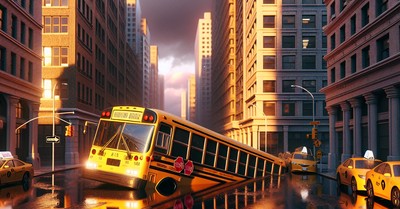
Those oddly warped street scenes in Pragmata’s trailers—the ones where a bus is half-swallowed by asphalt—aren’t mistakes. They’re the point. Capcom’s action shooter leans into the unease of AI imagery for its New York section, but without actually using AI to build it.
Director Cho Yonghee spelled out the concept in a recent interview with 4Gamer, translated by Automaton. "For Pragmata, we set the premise as 'a fake New York generated by AI,'" he said. The team wanted players to recognize the place, then flinch at the details. "When familiar locations appear, players can relate more easily. On top of that, to make it clear that this isn’t the real New York, we wanted something slightly distorted."
That distortion is the visual language. It nods to the way AI image models mangle everyday logic—hands with extra fingers, signage that almost says something—except here the glitches are authored. Producer Naoto Oyama put it plainly: "Although the premise is that it is generated by AI, actually, our human developers painstakingly worked to incorporate mechanisms that express this AI-like uncanny feel." In other words, the look is intentional and hand-made, not machine-spun.
How Capcom Built an "AI" City Without AI
The team’s approach leans on recognizable scaffolding with deliberate errors layered on top. You’ll see a New York that tracks with memory—avenues, crosswalks, a skyline that reads at a glance—then catches on the wrongness. Oyama pointed to specific hiccups that sell the illusion, like cars and buses jammed partway into the ground. Those surreal seams echo the telltale artifacts players associate with AI art, but they’ve been placed there by artists and level designers to evoke that same uneasy response.
It’s a neat inversion of the current conversation around tools. Plenty of executives are talking about the "inevitability" of AI, but Pragmata treats it as subject matter rather than production pipeline. The result invites players to read the world the way we now skim suspect images online: scanning for contradictions, counting the little slips that give the fake away. The familiar becomes a lure; the anomalies become the message.
By framing the setting as an AI imitation while keeping development human, the game doubles down on authorship. The quotes make that stance explicit. Yonghee’s emphasis on "familiar locations" and something "slightly distorted" signals a controlled gradient of weirdness, not a scattershot batch of machine errors. And when Oyama highlights "painstakingly worked" mechanisms, he’s underlining that craft—not automation—is driving the effect.
Reading the Glitches
Because the premise is baked into the environment, the city isn’t just a backdrop. It’s commentary. The wrong-way textures, misaligned geometry, and embedded vehicles aren’t just mood pieces; they’re cues about where you are and who—or what—built it. Games have long played with unreliable spaces, but tying those cues to the specific anxieties of AI-era imagery gives Pragmata a sharper hook. It’s not parody. It’s closer to a guided misread of reality.
This decision also solves a design problem: how to make a mega-famous city feel fresh without discarding its identity. New York is overexposed in media, but a "fake New York generated by AI" lets Capcom show recognizable silhouettes while giving players something to puzzle over. You get the hit of recognition and the friction of doubt in the same frame.
There’s also a practical upside for gameplay. Those distortions create readable landmarks—the bus fused into a lane, the curb that warps into a ramp—that can double as navigational anchors or combat spaces. If the team keeps threading that needle, the environment can carry both theme and function without turning into a messy collage.
When You Can Play It
Capcom has Pragmata slated for April 17. Trailers have already foregrounded the city’s off-kilter personality, and the studio’s comments make clear that the unsettling vibe is authored, not outsourced to a generator. Expect the New York section to lean on that tension between recognition and error, using handcrafted "AI mistakes" as a stylistic toolkit.
I’m curious how far the trick can stretch. If the team escalates the glitches with intent—starting with "slightly distorted" and building to stranger breaks in logic—the city could chart a satisfying arc from uncanny to outright hostile. And if it lands, Pragmata might set a useful template: treating AI not as a shortcut, but as a topic, and trusting artists to do what machines can’t—decide exactly where the wrongness belongs.