
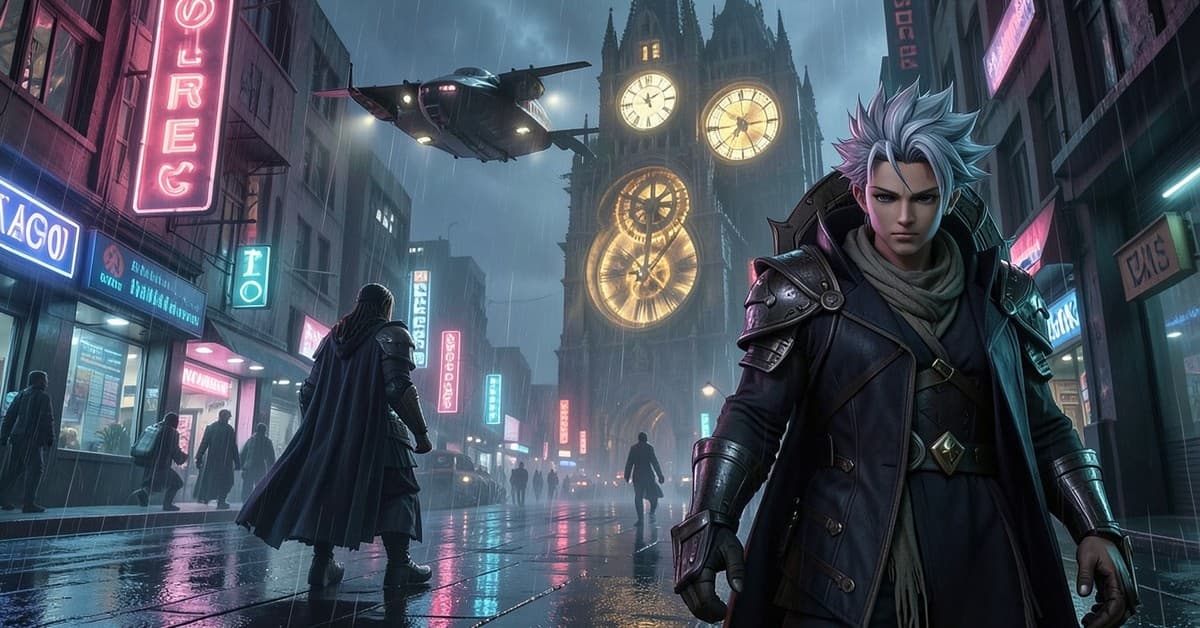
A fan project titled Final Fantasy Resonance has surfaced online, presenting a speculative trailer that poses a bold creative question: what happens to the video game medium if Final Fantasy 7 never releases in 1997? The trailer, produced by a dedicated community creator, does not simply remix existing assets; it constructs an alternate timeline where the PlayStation era unfolds without the RPG that popularized the genre globally. For anyone who grew up watching Cloud Strife's Buster Sword become a cultural touchstone, the premise immediately reframes decades of gaming history in a single, unsettling thought experiment.
The significance of this project extends beyond nostalgia. Final Fantasy 7 did not just sell millions of copies — it shifted the industry's center of gravity toward cinematic storytelling, 3D worlds, and mainstream acceptance of Japanese role-playing games outside Japan. Removing that catalyst from the timeline forces a reconsideration of how franchises like Persona, Xenoblade, or even The Witcher might have evolved without the commercial proof-of-concept that Square's blockbuster provided. The trailer serves as a reminder that creative milestones are rarely inevitable; they are contingent on specific works breaking through at specific moments.
World Without Cloud, Sephiroth
The Final Fantasy Resonance trailer opens with a desaturated version of Midgar, stripped of its mako glow and presented as a generic industrial dystopia rather than a character in its own right. Familiar faces appear but recast: Cloud wears a standard SOLDIER uniform without the iconic pauldron, Tifa runs a nondescript bar without the Seventh Heaven signage, and Sephiroth is absent entirely — replaced by a faceless corporate antagonist that could belong to any late-90s sci-fi property. The camera lingers on environments that feel deliberately anonymous, emphasizing how much visual identity the original game contributed to the medium's vocabulary.
Combat sequences in the trailer adopt a purely turn-based presentation reminiscent of the 16-bit era, with no Active Time Battle innovation on display. Menu interfaces resemble early Super Famicom RPGs, and summon animations are reduced to static portraits rather than the elaborate cinematic sequences that became a series hallmark. The absence of Limit Breaks, Materia combinations, and the distinct job-system flexibility underscores how many mechanical conventions players now take for granted were popularized or codified by that single 1997 release. Even the musical cues avoid Nobuo Uematsu's leitmotifs, substituting generic orchestral swells that could score any fantasy narrative.
Text overlays throughout the trailer mark divergent historical branches: "No PlayStation dominance in Japan," "RPGs remain niche in the West," "Cinematic storytelling delayed by a console generation." These assertions are speculative by nature, but they align with arguments historians have made about Final Fantasy 7's role in expanding the PlayStation install base and proving that story-heavy games could sell to mainstream audiences. The trailer does not claim to predict an accurate alternate history — it uses exaggeration to make the original game's influence visible by subtraction.
What the Missing FF7 Really Cost Us
- Project title: Final Fantasy Resonance (fan-made conceptual trailer)
- Core premise: Alternate history where Final Fantasy 7 was never developed or released
- Creator: Independent community developer (name not publicly disclosed in source)
- Platform: Video hosted on social media and video-sharing platforms
- Status: Conceptual art project, not a playable game or official Square Enix product
- Key visual contrasts: Generic 90s RPG aesthetics replacing Final Fantasy 7's distinct identity
The trailer concludes with a montage of real-world gaming milestones — the PlayStation 2 launch, the rise of Western RPGs, the modern remake trilogy — each fading into static as the timeline unravels. It is a melancholic ending for a project built on removal rather than addition. Yet the very existence of such a thorough deconstruction proves the opposite of its premise: Final Fantasy 7's fingerprints are so deeply embedded in the medium that even imagining their absence requires reconstructing the entire edifice of modern gaming. That is perhaps the strongest argument for the game's legacy, delivered not through praise but through a carefully crafted void.
Key Takeaways
- Final Fantasy Resonance is a fan-made trailer imagining an alternate history without Final Fantasy 7
- The project visually and mechanically strips away innovations the 1997 game popularized
- Cloud, Tifa, and Midgar appear recast as generic RPG archetypes without their iconic designs
- The trailer argues Final Fantasy 7 catalyzed mainstream RPG acceptance and cinematic storytelling