
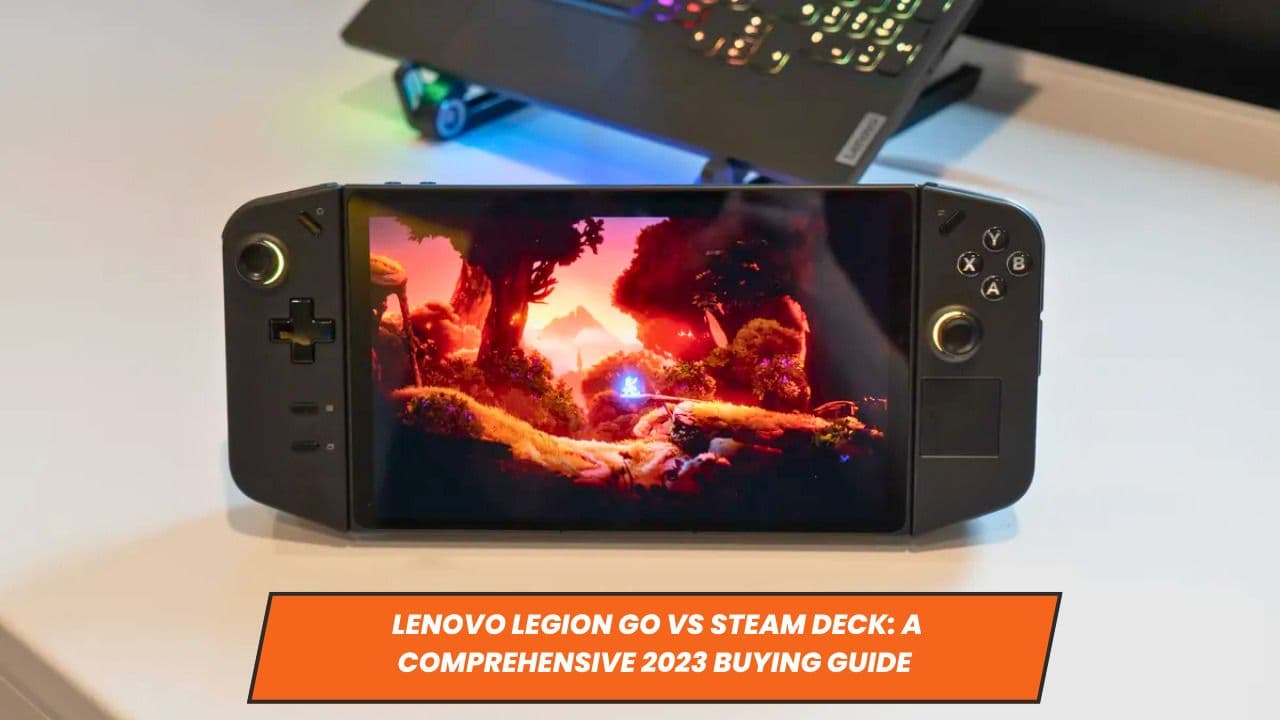
In recent times, the handheld gaming console market has seen significant developments, with the Lenovo Legion Go and Steam Deck emerging as prominent contenders. This detailed comparison seeks to elucidate the features, specifications, and potential performance metrics of these devices, facilitating informed decision-making for prospective buyers. Here, we delve deep into several vital aspects, including pricing, specifications, performance, software compatibility, and design attributes.
Price, Availability, and Specifications
Steam Deck
The Steam Deck, introduced by Valve, has been in the market since February 2022. The console is available in three storage variants: 64GB, 256GB, and 512GB, priced starting at $399. The basic model offers eMMC storage, while the other two variants boast NVMe SSDs, providing faster read and write speeds. The premium 512GB variant, priced at $649 in the US, comes with notable add-ons like an anti-glare etched glass and a proprietary carrying case. However, acquiring a refurbished unit presently poses a challenge due to stock constraints.
Lenovo Legion Go
On the other hand, the Lenovo Legion Go, unveiled at the IFA this year, is slated for release in the coming month, with prices commencing at $699. While detailed configurations remain under wraps, it is anticipated that the base model will house a 512GB PCIe Gen4 SSD and an AMD Ryzen Z1 chip. The high-end variant might feature an AMD Ryzen Z1 Extreme APU coupled with a 1TB SSD. Both versions are expected to incorporate a 16GB 7500MHz LPDDR5X RAM, promising robust performance.
For a direct comparison, we present a detailed table delineating the critical specifications of both handheld gaming consoles:
| Aspect | Lenovo Legion Go | Steam Deck |
|---|---|---|
| Dimensions | 8.27 x 5.15 x 0.79 inches | 11.7 x 4.6 x 1.9 inches |
| Weight | Starting at 1.41 pounds | 1.48 pounds |
| Chipset | Up to AMD Ryzen Z1 Extreme (8 cores, 16 threads, up to 5.1GHz, 16MB L3 cache) | Custom AMD Zen 2-based processor (4 cores, 8 threads, up to 3.5GHz) |
| RAM | 16GB LPDDR5x 7500Mhz | 16GB LPDDR5 5600MHz |
| Storage | 256GB, 512GB, 1TB PCIe 4.0 NVMe M.2 2242 SSD | Up to 512GB M.2 2230 SSD |
| Display | 8.8-inch IPS, Quad HD+, 144Hz refresh rate, 97% DCI-P3, 500 nits, touch-enabled | 7-inch IPS, 1280x800, 60Hz touchscreen, optional scratch-resistant glass coating |
| Graphics | AMD RDNA 3 Graphics (up to 12 cores) | AMD RDNA 2-based graphics, 8 CUs |
| Ports | 2x USB4, 3.5mm headphone jack, microSD card reader | 1x USB-C 3.2 Gen 2, 3.5mm headphone jack |
Performance and Battery Life
Evaluating the consoles from a performance perspective, the Lenovo Legion Go appears to be the superior contender due to its advanced APU. The console, potentially equipped with a Ryzen Z1 Extreme APU, promises formidable gaming performance, rivalling its established competitor, the Asus ROG Ally. Based on preliminary data, the Legion Go is predicted to offer comparable, if not superior, performance at similar resolution and graphics settings.
Conversely, the Steam Deck harbours a custom AMD Zen 2-based processor, which operates at a maximum frequency of 3.5GHz, possibly rendering lower frame rates in high-demand titles like Cyberpunk 2077 compared to the Legion Go. Nevertheless, it should be noted that actual performance can only be ascertained through hands-on testing.
Regarding battery life, the Steam Deck accommodates a 40Whr battery, offering a usage time ranging between two and eight hours, contingent upon the game complexity. The Legion Go, featuring a 42.9Whr battery, promises extended gaming sessions, albeit the actual battery longevity remains to be tested.
Software and Game Compatibility
The Lenovo Legion Go, running on Windows 11, provides unrestricted access to a plethora of gaming platforms, including Epic Games Store and Xbox, enhancing gaming versatility. However, the Steam Deck, equipped.
with a Linux-based SteamOS 3.0, presents an initial selection of compatible titles, though efforts are ongoing to widen the available gaming library.
Design and Ergonomics
Both consoles manifest distinct design philosophies. While the Lenovo Legion Go embodies a sleek, compact build with a glass rear panel, the Steam Deck adopts a more substantial form factor. Ergonomically, the Steam Deck offers a comfortable grip with its unique button layout and joystick placement. In contrast, the Legion Go accentuates user comfort with its adjustable kickstand and detachable controllers, facilitating multi-modal gaming experiences.
Conclusion
In conclusion, both the Lenovo Legion Go and the Steam Deck stand as formidable choices for handheld gaming consoles in 2023. Prospective buyers should weigh the specifications, performance metrics, and design attributes meticulously before making an acquisition. It is advised to keep an eye on further developments and reviews to glean deeper insights into these consoles' real-world performance and utility.


