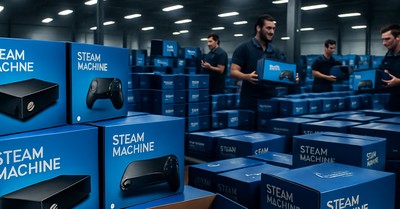

Valve's upcoming Steam Machine, often likened to a spiritual successor to the Nintendo GameCube due to its compact design for couch gaming, has had its launch details partially exposed through a code leak on the company's store page. The leak, scrutinized by enthusiasts and reported via WCCF Tech, indicates that the Steam Machine will debut with four different SKUs (Stock Keeping Units), catering to various consumer preferences and, notably, incorporating measures to deter scalpers, a challenge Valve previously faced with the rapid sell-out of the Steam Controller in under 30 minutes.
The core specifications of the Steam Machine, consistent across all models, include SteamOS, a semi-custom AMD CPU and GPU, 16GB of DDR5 RAM, and 8GB GDDR6 VRAM. The primary differentiation among the SKUs lies in storage capacity, with two confirmed models: a 512GB version and a 2TB version. The 512GB model has raised concerns among gamers and analysts alike, given its limited storage capacity in the context of modern AAA game sizes. For example, Forza Horizon 6 requires nearly 160GB, and Call of Duty titles can exceed 250GB, highlighting the 512GB model's potential to fill up quickly with just a few games.
About the Steam Machine SKUs and Scalper Measures
The other two SKUs remain speculative but are likely to include bundles that pair the Steam Machine with the Steam Controller, given their designed synergy. Valve's approach to combating scalpers involves a registration queue, purchase limits of one unit per account, and a requirement for the Steam account to be in "good standing" with prior purchases before April 27, 2026. This strategy will first be tested with the Steam Controller's launch on May 4.
Critics have argued that the requirement for prior purchases could unfairly impact new users looking to enter PC gaming with the Steam Machine. However, the necessity of purchase limits to prevent scalping is broadly acknowledged. The code leak also mentions the Steam Frame, Valve's VR hat scheduled for a 2026 release, indicating a significant hardware rollout year for the company.
Implications for Players and the Gaming Community
The revelation of the Steam Machine's specs and SKUs has significant implications for potential buyers. The uniformity in CPU, GPU, RAM, and VRAM across all models ensures a consistent gaming experience, regardless of the storage choice. However, the storage options will heavily influence the purchasing decision, with the 2TB model being more future-proof but likely at a higher cost. The 512GB model, while possibly more affordable, may require frequent game management due to its limited capacity.
The anti-scalper measures, if effective, will benefit the broader gaming community by ensuring more units are available to end-users rather than being stockpiled by resellers. The success of these measures with the Steam Controller's restock will be closely watched as a precursor to the Steam Machine's launch strategy.
What This Means for Players
For gamers eyeing the Steam Machine, the key takeaway is to weigh the storage needs carefully, considering the rapid growth in game sizes. The 512GB model, while potentially cheaper, may not offer the best value in the long run due to its limited capacity. Meanwhile, the assurance of consistent performance across all SKUs is a positive, especially for those seeking a hassle-free, console-like PC gaming experience.
The community's response to the news has been mixed, with appreciation for the scalper-deterrent strategies but concern over the accessibility of the purchase requirements for new gamers. As one gamer noted, "While I understand the need to prevent scalping, requiring prior purchases might lock out newcomers who want to start with the Steam Machine."
Valve's hardware ambitions for 2026, including the Steam Frame VR hat, position the company for a significant impact on the gaming landscape. However, the pricing strategy for the Steam Machine, especially the justification for the 512GB model, will be under scrutiny as more details emerge.
Criticisms and Room for Improvement
The most vocal criticism surrounds the 512GB model, deemed insufficient for modern gaming needs. The absence of a mid-tier storage option, such as 1TB, has also been lamented, as it could offer a better balance between cost and capacity. Valve's decision to include such a low storage option, despite the high specs in other areas, has been questioned, with some speculating it may be a cost-cutting measure that undermines the user experience.
Furthermore, the purchase restrictions, while understandable in their intent, might inadvertently create barriers for new users. A more nuanced approach, potentially incorporating alternative verification methods for new accounts, could better balance accessibility with the fight against scalping.
Key Takeaways
- Steam Machine to launch with four SKUs, including 512GB and 2TB storage models.
- Uniform specs across models: SteamOS, semi-custom AMD CPU/GPU, 16GB DDR5, 8GB GDDR6 VRAM.
- Anti-scalper measures include account registration, purchase limits, and prior purchase requirements.
- Steam Controller launches May 4, with Steam Machine and Steam Frame (VR hat) slated for 2026.
As the gaming community awaits the official launch details, including pricing and the exact nature of the unbisclosed SKUs, Valve's approach will be closely scrutinized for its impact on both the consumer experience and the broader battle against scalping in the tech and gaming industries.