The Shot That Reeked — Literally
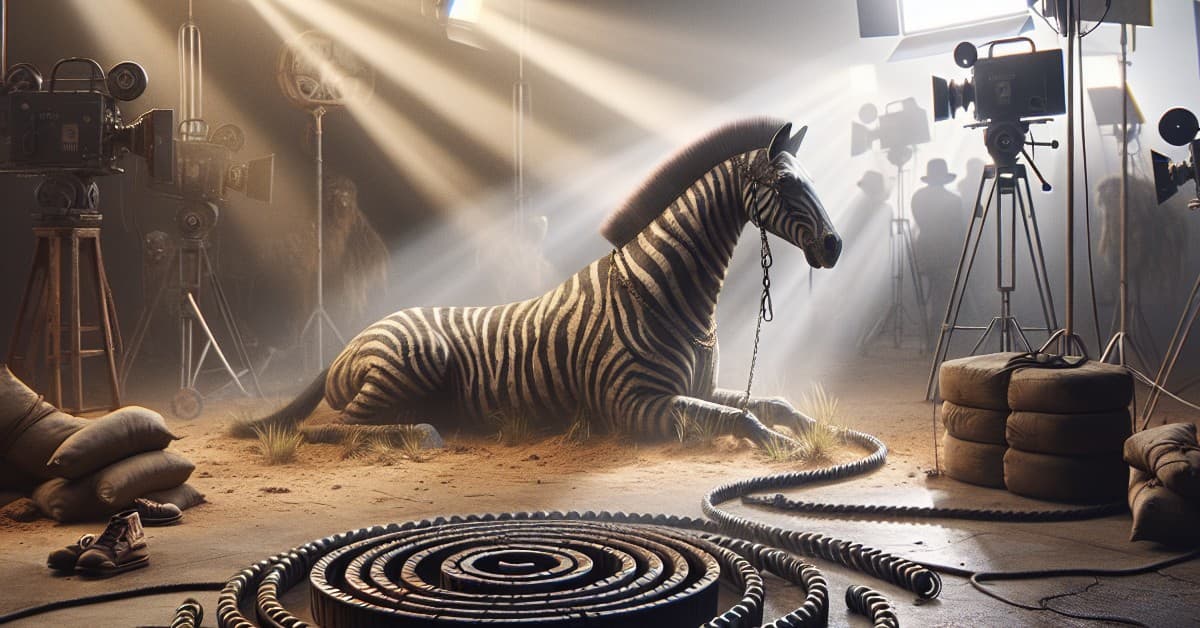
Stanley Kubrick wanted a predator tearing into a zebra under moonlight. What he got, according to effects legend Douglas Trumbull, was a drugged big cat chained to a painted, rotting horse on an English soundstage. The grisly setup produced one of 2001: A Space Odyssey’s most notorious images from the Dawn of Man sequence — the leopard draped beside its kill — and it came together in a way that’s as stomach-turning as it sounds.
In a 1978 interview archived online, Trumbull recalled Kubrick’s request: “It wasn't in the script, but Stanley wanted this scene with some kind of predatory animal eating a dead zebra at night.” Finding a zebra in England was hard enough; finding a dead one without killing it for the film was impossible. Trumbull’s fix: “How about a dead horse? We'll paint it to look like a zebra.” Kubrick agreed, with one condition: “I don't want anybody to go kill a horse for me, either.”
They located a horse “that was going to die any minute,” waited until it “finally croaked,” then dragged the carcass to the studio and striped it. Then the schedule slipped. “There was this dead horse which got really foul, ’cause it laid around about a week before they shot the scene,” Trumbull said. Film historian James Delson noted the crew had to “drug the jaguar and chain it to the zebra” because the animal wanted nothing to do with a week-old carcass. “With all the animals they had there, the place smelled like hell,” Trumbull added.
Trumbull’s Salty Recollections
Trumbull’s stories arrive with baggage. He and Kubrick clashed after 2001 won the Academy Award for Best Special Visual Effects and Kubrick took sole credit. “Kubrick did not create the visual effects. He directed them,” Trumbull told The Hollywood Reporter decades later. “There was a certain level of inappropriateness to taking that Oscar.” That tension colors the 1978 conversation, but the details he shares are specific and, frankly, hard to invent — like the painted horse and the chained cat.
The same interview also paints a picture of a project that began far rougher than its final form suggests. “I wish I had a copy of the original screenplay that I saw when I started working on the picture, so you could see what a piece of crap it was,” Trumbull said. He described script pages that literally read, “Special effects sequence starts here. Work is now under way with our crew of artists and technicians to produce the most fantastic visual effects ever made,” followed by blank space. In his telling, Kubrick was using those placeholders to get MGM rolling while he and Arthur C. Clarke argued over the story’s direction.
From Hologram Cubes To 20-Foot Aliens
Many of the film’s defining ideas weren’t in that early draft, Trumbull said. The iconic monolith, for one, began as “a transparent cube right by the watering hole” that would play “a big holographic teaching film” showing apes “how to pick up a bone and how to clonk an animal until he's dead, and then how to eat him.” Too on the nose, too fussy, and ultimately replaced with the silent, unknowable slab that’s haunted film history ever since.
Even more surprising: no HAL 9000. Trumbull recalled a version where five astronauts traveled to Jupiter, discovered “a big rectangular hole in one of Jupiter’s moons,” and peered into another star system. “They say, ‘Oh groovy, time warp,’ or something like that,” he said. Probes disappeared into the slot. Eventually a pair of astronauts followed, fell through caverns, reached a “strange room,” and met “this giant 20-foot-tall green man.” Kubrick, Trumbull said, obsessed over how to realize those aliens instead of tightening the script.
Trumbull claims he pushed for a cleaner structure. “If this movie is going to end with one or two guys in this room, you've left too many loose ends. You've still got the other guys out there in the spaceship. What are they doing? … Wouldn't it be better if you just had one man, and wouldn't it be better if something went wrong back at the ship. Why not kill all those guys?” The finished film does exactly that, with HAL methodically eliminating the crew until only Dave Bowman remains — a sharper, colder idea than rubber monsters or expository holograms.
The Mess Behind A Masterwork
None of this diminishes Kubrick’s achievement; it reframes it. 2001 wasn’t born pristine. It lurched through false starts, awkward drafts, and, yes, a foul-smelling soundstage with a chained big cat that wanted out. Trumbull’s account suggests a filmmaker chasing images first — the leopard at the zebra, the monolith at dawn — and trusting that the right structure would harden around them. Sometimes it did. Sometimes someone else, like Trumbull, had to nudge it there.
More than half a century later, the film’s cool precision hides the heat and chaos that built it. The VFX rancor, the painted “zebra,” the abandoned 20-foot alien — they all underline how volatile big swings can be while they’re still in the air. If anything, the story sharpens 2001’s legacy: a masterpiece assembled from unruly parts, made by people who didn’t always agree, and powered by images bold enough to risk a week-old horse and a sedated cat to get them. Would that fly now? It shouldn’t. But it explains why the result still feels dangerous.