Fast Matches, Big Stakes
Seven turns. That’s the target length of a Cyberpunk TCG match before it flips into overtime, and you feel that urgency from the first roll. My 30-minute PAX East 2026 playtest wrapped early at the proctor’s signal, yet the tempo made every decision sting or sing. It moves fast in a way most card games don’t, and that pace might be its biggest hook as the game heads toward a full launch later this year with more than $15.75 million already behind it on Kickstarter.
Despite a learning curve and a few rules checks, I came within a whisker of closing out my opponent. The short round timer clipped the finish, but the momentum was clear. Compared to a typical 45-minute Magic Arena grind, this was punchy, tense, and clean. I walked away wanting another go immediately.
How Street Cred and Gigs Drive the Game
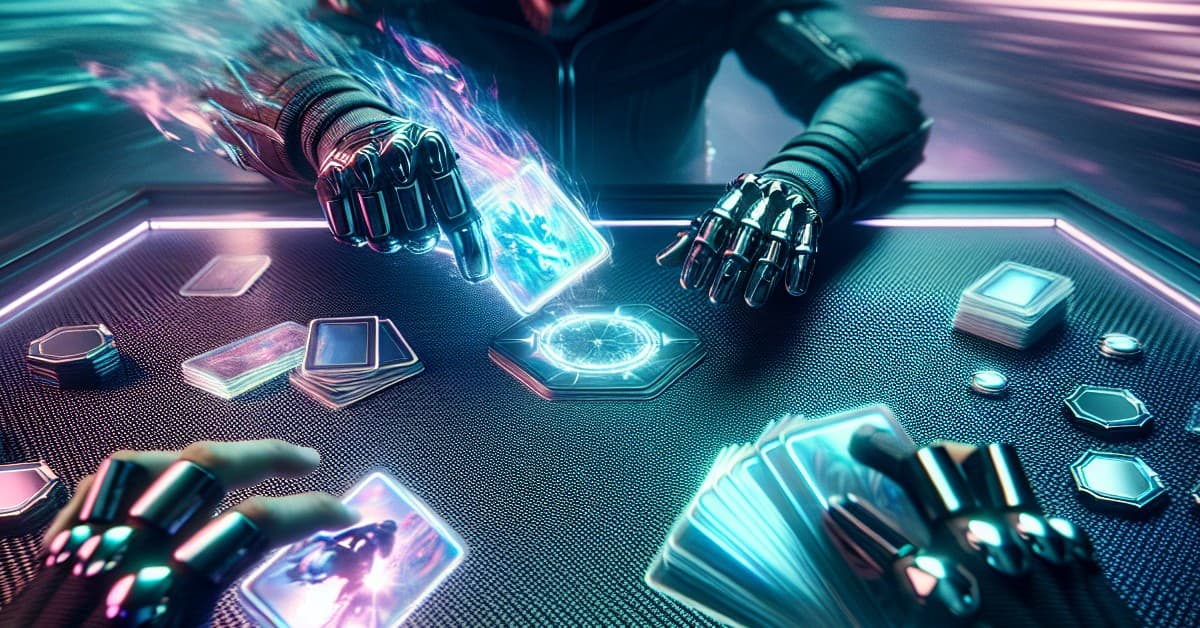
Every player begins with six Gig Dice in a fixer zone along the left side of the mat. At the start of your turn you draw a card, then pick and roll one die from a lineup of d4, d6, d8, d10, d12, and d20. The d20 has to come last. That die slides into your gigs zone, and its roll adds to your total Street Cred, a running number that turns on bonus effects across the card pool.
That economy pushes risk and reward in subtle ways. You’ll want to spike your Street Cred early to unlock certain gear payoffs, but overextending can burn you. If an attacker hits face and goes unblocked, they steal a gig die of their choice; for every 10 power that unit has, they snag an extra gig. Jumping straight to a d12 on turn one feels tempting—until your opponent rips it away and swings the race.
Payoffs are immediate and mean. In one sequence, I equipped Dying Night: V’s Pistol, which snipes an opposing gear that costs 2 whenever the equipped unit or legend attacks and you’re at seven or more Street Cred. When that trigger blew up my opponent’s Mantis Blades mid-game, he visibly grimaced. That kind of swing gives the match a street-fight texture: one good hit can change the night.
Eddies, Legends, and Building a Crew
Resources track cleanly. Cards with a sell tag (€$) can be sold for Eddies, then played facedown as a resource you turn sideways when used—Cyberpunk TCG calls this state "spent." Units also become spent when they attack or use certain abilities. The flow is familiar if you’ve touched other TCGs, but the terminology leans into the setting without getting in the way.
Each player also starts with three facedown Legend cards that can be spent for Eddies. Spend two Eddies to flip a Legend face-up, and it functions like a Commander-style anchor. Some jump into play as units; others sit back and grant ongoing bonuses. My opponent’s Arasaka-themed deck had a Legend that gave +1 power to every Arasaka unit on attack, and another that drew a card the first time an Arasaka unit attacked each turn. Left unchecked, those triggers pile advantage fast.
Deck construction pulls from a RAM system that gates what you can run. Legends have a RAM color (their border) and a RAM value in the top-right; together, your three Legends set your deck’s color access and total RAM cap. With my Edgerunners list, V: Corporate Exile and Jackie Welles: Pour One Out for Me were both blue with RAM 2, while Viktor Vektor: Sit Down and Relax added two yellow RAM. That translated to bigger blue payoffs and lighter yellow splashes. On the other side of the table, the red-green Arasaka build was straightforward and aggressive—more bodies, more gear, less fuss.
The Moment That Flipped the Table
The match’s cleanest high point came late. My opponent dropped Goro Takemura: Losing His Way for four Eddies—a 5-power unit that gains +1 for each of his face-up Legends, which put Goro at 7. Next turn, he strapped on a Sandevistan for +3. A 10-power threat in these alpha decks bulldozes most boards. I chumped with a very humble Secondhand Bombus just to blunt the damage.
Then I top-decked Floor It, a clutch answer that returns a spent unit with cost four or less to its owner’s hand. I flagged the proctor. "What happens to attached gear when a unit is removed from play?" I asked. "It goes in the trash," he said. We both laughed—calling the discard pile TRASH is a perfect bit of flavor. I apologized—"I’m so sorry"—and bounced Goro. The Sandevistan hit the TRASH for good. One direct swing later, I stole a gig die and flipped the counts to five for me, three for him. The proctor clapped once to end the session. Abrupt? Sure. But the gear check, the theft, and the tempo told the whole story in under half an hour.
Why The Pace Works
Because victory is simply having six gig dice at the start of your turn, every decision points at that finish line. Do you roll higher now for Street Cred triggers, or sandbag to avoid a painful steal? Do you flip Legends early for payoffs, or bank Eddies to widen your board? The framework nudges you toward tight, interactive play, and the seven-turn design encourages best-of-three sets without burning an evening.
These were simple alpha decks, yet the RAM color identities already hint at distinct strategies—draw and trickery in blue, tempo buffs and bounce, and a red-green package built to pressure. With the campaign now the highest-funded game on any crowdfunding platform and a war chest north of $15.75 million, the real questions shift to tuning: how fast formats settle, how Legends define archetypes, and whether gear-centric lines stay as swingy as they felt here. If the published set keeps this cadence and clarity, I’ll happily queue up for the next match.